 In 2019 I came across a book called Travels with A Stick, written by Richard Frazer, the minister of Greyfriars Kirk in Edinburgh. It describes his pilgrimage to Santiago de Compostela, one of the oldest, and best known, pilgrim routes in Europe. Not a controversial topic you might think, yet it’s one which, until recently, would have been frowned upon by many protestant denominations.
For the Reformers, pilgrimage was regarded as little more than a money-making enterprise, the proceeds of which made their way to Rome, leaving poor peasants even poorer: part of a church-run money-making scheme to encourage people to buy their way into heaven. A commercialising of Christianity and definitely not in keeping with the gospels. With the Reformation the medieval heyday of pilgrimage came to an end.
 Yet for our ancestors pilgrimage was important – and no easy matter. It involved hardship and expense, often travelling long distances over land and sea in the hope of a cure for illness, or enlightenment, or to atone for sins, or for protection against the vagaries of life. Sometimes simply a sense of freedom from very restricted lives – a holiday. Their destinations were the shrines of saints noted for specific powers. To see, touch and be blessed by proximity to holy relics. To us this may seem more like superstition than belief. Yet, despite that, our modern world has seen a renaissance of pilgrimage.
The 19th century saw changes in the understanding of spirituality. While material progress was evident in the Agricultural and Industrial Revolutions, there was still a hunger in many people for something more in their lives. And this was not necessarily a need that was being met in conventional religion. Bodily needs were acknowledged (though all too often not met), but what about spiritual needs?
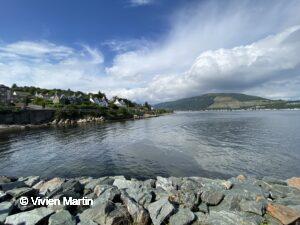 By the 20th century some of the older pilgrim routes in traditionally Catholic countries were slowly revived and today they are flourishing. One of the best known is undoubtedly the Camino de Santiago, The Way of St James. It’s made up of a vast network of smaller pilgrim trails, trails that flow like burns into an ever-widening river. A river that leads in this case to the shrine of St James in the cathedral of Santiago de Compostela in northwestern Spain. With the collapse of the Soviet Union, ancient routes from the Baltic states have rejoined the trail, running through Poland, Germany and France on their way to Spain.
But what of Protestant attitudes to pilgrimage? One man who has been instrumental in the revival of pilgrimage in Scotland, and in particular the Church of Scotland’s decision to reverse 450 years of opposition to it, is the above-mentioned Richard Frazer. For him the journey, wherever it is made, is less about religiosity and more about spirituality: our faith seen as an ongoing journey. “Pilgrimage,” he writes, “If undertaken with an open heart can offer profound spiritual renewal, bring us to the mystery of what it is to be human and vulnerable, and open us to the gifts of the new and the unexpected.” And it’s a search that’s not exclusive to Christians.
 Despite the Reformers historic disquiet with pilgrimage, we’re surprisingly fortunate in Scotland, where many places combine the ‘ingredients’ of pilgrimage. Landscapes rich with spiritual significance, be they megalithic stone circles, caves, beehive Celtic cells, monasteries or cathedrals. Places where peace and stillness prevail. Places where generations have prayed and sought God. Places that have become regarded as special, holy sites. Sacred because of their closeness to something other, something spiritual. The thin places of the Celts. Intangible, yet definitely there, the power of place can be very strong indeed.
When we think of sacred sites in Scotland, Whithorn and Iona are two that come to mind. But there are others, and the Scottish Pilgrim Routes Forum is a fascinating source of information on these. The physical act of walking these routes allows a re-discovering of the landscape, a re-connecting to the natural world. And (thankfully!) they need not always be long-distance routes!
 Take for example, Faith in Cowal, a direct response to the General Assembly of 2017 which encouraged congregations to embrace pilgrimage locally. The project focuses on the exploration of the early Christian landscape of Cowal, linking fifteen sites, all with ties to Celtic or Medieval Christianity. One is Ardtaraig Chapel, another Ardnadam, just north of Dunoon, one of the earliest Christian sites in Argyll. As well as the footings of the ancient chapel walls, burials were found, marked with primitive cross-carved stones. The chapel and graves sit within in the middle of a pre-Christian Iron Age enclosure. Layer upon layer of history in one place.
Faith in Cowal is only one of a growing number of local pilgrim trails, and is an opportunity for a break with a difference, a walk with a purpose. Time for reflection and to enjoy the glorious landscape. To walk in the footsteps of other Christians, with a sense of pilgrimage to add a spiritual dimension to the journey.
Scotland may have come late to this particular party, but we’re definitely making up for lost time now!
https://www.faithincowal.org/
https://www.sprf.org.uk/routes
(This article first appeared in Jordanhill Parish Church Link Magazine, March 2023)

 A question: What do William Shakespeare, Jules Verne, Agatha Christie, Peter May and Enid Blyton all have in common? And the answer? They’ve all used islands as settings for some of their most exciting and memorable works.
 ‘Climb every mountain …’
  Whose blood flows through your veins? Are you descended from dark-haired Celts, or fair-haired Norse Vikings. Or even those unfortunate Spanish sailors whose ships floundered in the stormy waters off the Scottish coasts in the aftermath of the Spanish Armada of 1588 and stayed on (think of Jimmy Perez!).


 And it’s a place to explore and spend time on. To stop for a while and ponder on the lives of those men and women who chose to live here in the past. And perhaps even to wonder what they would make of our lives today? Of our priorities and beliefs? Of our feelings and actions towards our fellows? What would they think of us, I wonder? Now that would be interesting!

 The first time I experienced a serious earthquake was in 1984 in Soviet Central Asia. We were in Uzbekistan, an area of high seismic activity, and though the local people took the quake in their stride, it left us more than a little shaken. It was soon obvious that the older, traditional, mudbrick houses ‘moved’ with the quake, thereby suffering little damage. But for the more modern Soviet buildings of concrete, steel and chrome, it was a different story altogether. Buckled metal and twisted doors were followed by a fair amount of consternation as to how, or even if, the damage could be repaired.
 Earthquakes can be fearsome things even when we know what’s causing them. But imagine what it must have been like for our ancestors as they tried to make sense of the mysterious and often destructive heaving of the planet. We can see their attempts to explain earthquakes in primitive myths and legends: those frightening tales of titans, giants and monsters. Tales of fearsome and unpredictable entities forever fighting, hurling huge, mountain-sized boulders at one another – causing, it was believed, earthquakes. And if not that, then blame the Wrath of God!


 A recent edition of the BBC Radio 4 Sunday programme, hosted by Edward Stourton, looked at an excellent new book by Professor Ian Bradley; ‘The Coffin Roads: Journeys to the West’ and I was delighted to be asked to contribute to the item. I chose a route not too far from my home which we’ve walked many times: The Stoneymollan Road. It’s a former coffin road that runs from Balloch, at the foot of Loch Lomond, to the burial ground at St Mahew’s Chapel in the clachan of Kirkton, not far from Cardross. You can listen to Professor Bradley and myself in the coffin roads item here (at 18.04 minutes in):
  While Stoneymollan may no longer be used as a coffin road, it’s a fascinating part of our country’s history. One that ties in with Scotland’s long maritime past that saw early missionary monks travelling the sea roads of the west, bringing Christianity with them. It also shows the importance of landscape in shaping the life of a nation. And, for me at least, knowing the history of this route adds a very memorable element to walking the Stoneymollan Road.
 “
“
