

There’s an old saying that “curiosity killed the cat.” But I don’t go along with that. In fact, I believe it’s the exact opposite, a lack of curiosity, that ‘kills’ us. That stultifies our minds and our imagination. That closes our eyes to the possibilities of life and blunts our ability to have a vision of better things. Indeed, I think the Book of Proverbs hits the nail on the head when it says “Where there is no vision, the people perish.” Whether a vision for our individual lives, or for our nation, it’s curiosity that leads us to ask questions and explore different ways of doing things. It’s curiosity that leads us to say “What would Scotland be like if…?”
 Without curiosity people wouldn’t explore or experiment. Without curiosity early man wouldn’t have gone to see what was over the next hill or on the other side of that wide blue ocean. Without curiosity scientists and doctors wouldn’t have made the breakthroughs they have. Curiosity fuels our imagination and opens our eyes to connections we hadn’t noticed before. Just think of the complex process required to turn cocoa beans into chocolate and you have to marvel at human ingenuity!
 People have always been curious, trying to find ways – and the words – to understand the world around them. To explain the seasons, the floods and famine, as well as the bounty and beauty of the world. To understand why the world is the way it is.
Curiosity is a profound human trait, one that is not far from spirituality: a sense that there is something else out there, beyond our physical bodies and the here and now. With spirituality rather than religiosity at its heart, pilgrimage can offer the chance to walk, to think, to talk, to ask questions, to give thanks. To be close to the past, live well in the present and imagine the future.
 Pilgrimage is nothing new: Macbeth, Robert the Bruce and James IV all made pilgrimages. But today there’s a whole new generation looking at the old ways with contemporary eyes. And there are flourishing pilgrim routes all across Scotland and Europe. A modern pilgrim may venture forth for different reasons than those of the past. But that time out, re-connecting with the land, seeking to re-focus on what’s important and what we’re trying to do with our lives, is an experience worth considering. And fortunately Scotland is a country with a wealth of pilgrim routes, enriched by a long history of Celtic and medieval Christianity. So wherever you live, chances are there’s one pretty close to your doorstep!
In issue 68 of iScot Magazine I look at the history of pilgrimage: its rise and fall, and rise again and its myriad of forms.

 I’ve written about these issues before, but feel they’re worth revisiting becau
 In this month’s

 In the current issue of iScot magazine I take a look at the story behind the lives of the people of Torridon both past and present. At the challenges faced both then and now. And how we owe a great deal to those who went before us. It’s a fascinating area and though remote, there’s much more to it than you might at first believe.


 I often wonder what he and his contemporaries would make of Westminster today? Not a lot, I suspect. But without a shadow of a doubt, there’s much that today’s politicians could learn from Tom Johnston!
  It should have been happening this September, however, like so much at the moment, it’s been put on hold. Yes, that’s disappointing, but I suspect it’ll be twice as enjoyable when it does take place!
 There’s no doubt about it – North Uist can be windy! But that didn’t really bother us when we spent our summer holidays there a year or so ago. We’re used to Scottish weather, whatever the season. And we know how to dress for everything Scottish weather can throw at us – be it spring, summer, autumn or winter (and sometimes they can be hard to differentiate!)
 The last resident of the island came to a sticky end – thrown into a dungeon in a castle on Skye and left, not to starve to death, but given salted beef with nothing to drink and left to die slowly and agonisingly of thirst. Not a pleasant way to go!
 What connects a Highland wilderness, a former east-coast fishing town and Glasgow’s respectable West End? The answer? Crime! But fear not, it’s fictional crime I’m talking about!
 In the Highlands I’m often struck by that curious juxtaposition between the breathtaking landscapes and the tiny settlements scattered across them. Towering mountains and huge skies. All that space and yet so few people. What made Gareth Halliday chose this place for his debut novel From the Shadows?
 A document that contains the famous lines, “For so long as but a hundred of us remain alive, we shall never under any circumstances submit to the domination of the English. It is in truth not for glory, nor riches, nor honours that we are fighting, but for freedom alone, which no honest man gives up but with life itself.” And this is the ancient town where Jackie McLean sets her crime novels.
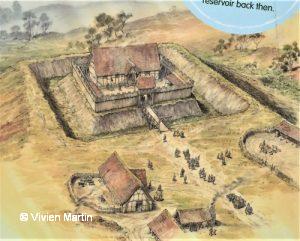
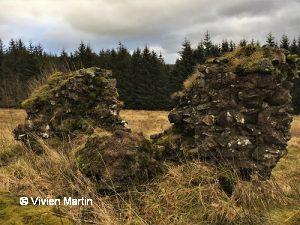
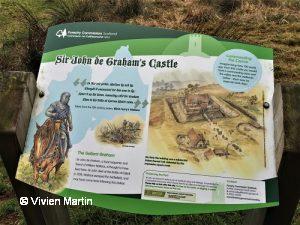
 The view might be very different from John de Graham’s time, but the setting is still as commanding. De Graham, friend and ally of William Wallace, is believed to have had his home on this spot, overlooking the Carron Valley in Stirlingshire. There’s a picture on the information board showing what the ‘castle’ would have looked like: a medieval earthwork with a substantial timber-framed hall, defended by an impressive square moat. The line of the moat is still very much in evidence, though nothing remains of the hall, and today the mighty Carron Reservoir fills much of the valley below.
 John de Graham of Dundaff (another name for this fortified site), was a 13th century Scottish noble who fought alongside Wallace in the First Scottish War of Independence, and who fell at the Battle of Falkirk on 22 July 1298. On that terrible day the Scots, unable to withstand the force of the heavy English armoured cavalry and the deadly Welsh longbows, were defeated by Edward I of England. De Graham died but Wallace survived and is said to have sought out de Graham’s body and carried it from the battlefield himself. De Graham was the most notable casualty of that terrrible day and is buried at Falkirk Old Parish Church. Wallace then retreated to de Graham’s home by the Carron Water.
 Many years later a famous narrative poem, The Actes and Deidis of the Illustre and Vallyeant Campioun Schir William Wallace (also known as The Wallace), was written by the poet Blind Harry. It portrays Sir John de Graham as one of William Wallace’s principal supporters and describes Wallace’s feelings of loss and sadness at the demise of his friend. There’s no doubt that de Graham’s death was a sore blow to Wallace, who lost not only his right-hand-man, but also a close friend.
 Ritchie continues, “Although Blind Harry’s poem was written long after the event, it does clearly link his Sir John de Graham to the area; and although the earthwork was likely built some years beforehand, it does mark the feudal estate of Dundaff, property of the de Graham family. Fact and fiction do seem to meet at Sir John de Graham’s castle to tell a story of place that is firmly rooted in the past.”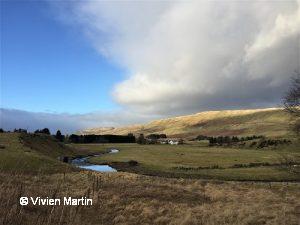
 I suspect some visitors head to Scotland believing it consists almost entirely of castles and ghosts. Not a surprising misconception, as that’s all too often the image presented to visitors by tourism agencies. While I agree that understanding the past is important, it’s also equally, if not more, important to be aware of what’s going on now and how that takes Scotland forward. There’s much more to Scotland than a romanticised past.
 With that in mind I took a trip up to Loch Fyne head to see what’s happening there. It’s an area I know well – long school holidays spent in the rambling manse in Inveraray saw to that! And then there’s the wonderful drive to get there – a real treat in itself. Up along the shores of Loch Lomond. Past Ardgartan and up into the Arrochar Alps with a welcome pause at Rest and Be Thankful. Then down to the small settlement at Clachan at the head of Loch Fyne.
 The visitors’ hub Here We Are is central to an impressive number of wide-ranging projects, showing just what can be achieved when a community is determined enough and not afraid to accept challenges. On their website I noticed an interesting and very pertinent quote by Magnus Linklater, “If we are not aware of our own values we become victims of other peoples’ decisions. We have to bend to their agenda rather than ours, and that means not just a lack of trust in ourselves, but an aversion to risk and an inability to take decisions of our own.” This local community has certainly shown how well trusting in themselves can work!