
 Remember the story of Bruce and the spider? That tale of how a tiny creature’s persistence provided the spur that Bruce needed to keep going in the face of insurmountable odds? With the benefit of hindsight we know that success was eventually to be his. But he didn’t know that. He had to face his darkest moment without knowing what the future would bring.
Bruce had suffered terrible losses; the barbaric torture and death of some of his closest family, the imprisonment of others, the loss of Scotland. How much easier it could have been for him to turn and run. Give up and disappear from history. But he didn’t.
Visiting the cave and writing about it for the current edition of Scottish Islands Explorer, I found myself thinking that the central message of Bruce’s tale resonates just as strongly today as it did all those centuries ago. Like Bruce, we often have to take a leap of faith, not knowing what the final outcome will be, but hoping that the decision we’ve made is the right one.
 Bruce faced terrible odds and knew only too well that his decision would impact on the lives of many, many people. That was a heavy responsibility. Right now, in countries like Syria and Yemen, men, women and children are facing the horrors of war, torture and starvation. Drug wars rage in South America. Torture and beheading in Saudi Arabia. Ours is not a peaceful world. Yet despite that, there are always those courageous enough to take the decision to stand up against oppressors, no matter how impossible the odds appear.
Fortunately our decisions seldom put us in physical danger, but they’re still important. They affect us as individuals, but also the wider community around us. So, like Robert the Bruce, what we decide to do – or not to do – is important for more than just ourselves.
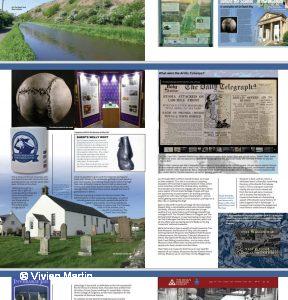
 Arran is a beautiful island; rich in geology, archaeology, history and natural beauty and this cave is full of signs that it’s been used for centuries. For one thing, it’s a treasure trove of carvings: everything from present day graffiti to ogham (Celtic) writing; animals, crosses, swords and much more. Carvings from the Bronze Age, early Christian era, Norse, Medieval, and Victorian times. It’s all there for the eagle-eyed to spot!
King’s Cave on Arran may or may not be the actual location of the Bruce story, but that moment in Bruce’s life was nonetheless a pivotal moment in Scotland’s history. The cave is an evocative place to visit and ponder on the courage it can take to stand up for our convictions. And should doubts arise, remember Bruce and his spider!


 Bute’s an island that’s often overlooked. Perhaps because it’s almost too close to the mainland. Or perhaps because people sometimes fail to look beyond the rather tired buildings of Rothesay’s seafront. But, as with most places, there’s definitely more to Bute, and its people, than meets the eye.
 Then, in 1898, he saved the life of young Malcolm McAlpine, son of the civil engineer Robert McAlpine, whose company still exists today. During the building of the West Highland Line extension to Mallaig, a devastating blast shattered that young man’s body and it looked as though nothing could be done to save his life. Yet, they hadn’t reckoned with the skill, dedication and compassion of William Macewen. The young man, who had been at death’s door, not only recovered, but lived to a ripe old age. And the West Highland Line extension was completed on time.
 Macewen was also the man who did so much for wounded soldiers, for those young men who returned with horrific injuries from the hellish battlefields of WW1. He designed the Erskine artificial limb and trained a team of engineers from a nearby shipyard to manufacture them for the newly-founded Erskine hospital. He worked tirelessly both on the mainland and on Bute to help his patients, no matter who they were.

 It’s not been an easy journey for either community. Neither have what we would consider ‘ease of access’, nor, until fairly recently, the opportunity to own the land they live on. However, you may have noticed that Inverie has been in the news again recently with talk


 Without curiosity people wouldn’t explore or experiment. Without curiosity early man wouldn’t have gone to see what was over the next hill or on the other side of that wide blue ocean. Without curiosity scientists and doctors wouldn’t have made the breakthroughs they have. Curiosity fuels our imagination and opens our eyes to connections we hadn’t noticed before. Just think of the complex process required to turn cocoa beans into chocolate and you have to marvel at human ingenuity!
 People have always been curious, trying to find ways – and the words – to understand the world around them. To explain the seasons, the floods and famine, as well as the bounty and beauty of the world. To understand why the world is the way it is.
 Pilgrimage is nothing new: Macbeth, Robert the Bruce and James IV all made pilgrimages. But today there’s a whole new generation looking at the old ways with contemporary eyes. And there are flourishing pilgrim routes all across Scotland and Europe. A modern pilgrim may venture forth for different reasons than those of the past. But that time out, re-connecting with the land, seeking to re-focus on what’s important and what we’re trying to do with our lives, is an experience worth considering. And fortunately Scotland is a country with a wealth of pilgrim routes, enriched by a long history of Celtic and medieval Christianity. So wherever you live, chances are there’s one pretty close to your doorstep!
 There are few things better than a good news story – and this has to be one of the best! When I posted news of my great-aunt’s debut novel on Facebook and Twitter, a novel completed at the age of 97 no less, I could never have foreseen the extraordinary outpouring of congratulations and good wishes it would give rise to. But more than that, there was a huge tide of thanks, and appreciation, from people to whom she has given hope. Her achievement has encouraged so many others.
 I created a new hashtag on social media yesterday, #NonagenarianNovelists. I created it to celebrate the publication of a debut novel written by my amazing 97-year-old great-aunt! Aberdeen-born and Huntly-bred, Tonie Ritchie completed her first novel this year. A great achievement for anyone, let alone a nonagenarian!
 She now lives in Plymouth where she’d returned in 1990 after Jimmy died. She then studied English at GCSE and A Level, before taking up creative writing and having several short stories and poems published.

 I’ve written about these issues before, but feel they’re worth revisiting becau
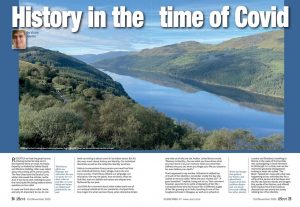 In this month’s
  The computer keyboard is getting well worn! From the author of The Peat Dead and The Dead of Jura, comes the first book in a spectacular new series – Death in Tallinn.