

As land ownership in Scotland clings grimly to its feudal roots, there are still far too many obstacles that make it hard, if not impossible, for Scots to live on and work the land. But it’s not only who owns the land that affects people’s lives, it’s also access. Access is vital for communities to survive and there can’t be many places in mainland Scotland that are as inaccessible as Inverie and Scoraig! Yet these two communities have shown that it’s possible to defy the odds and to thrive.
 It’s not been an easy journey for either community. Neither have what we would consider ‘ease of access’, nor, until fairly recently, the opportunity to own the land they live on. However, you may have noticed that Inverie has been in the news again recently with talk of a community buy-out of the ‘remotest pub in mainland Britain’, which happens to be none other than the Old Forge in Inverie.
Inverie is a small settlement on the Knoydart Peninsula, and although not an island per se, it might as well be, because the only way of reaching the village, and thereby enjoying a drink at the Old Forge, is either by walking 15 miles (25km) over rough terrain or taking the little ferry from Mallaig and making a seven-mile (11km) sea crossing into Loch Nevis. The choice is yours! (tip: we took the ferry!)

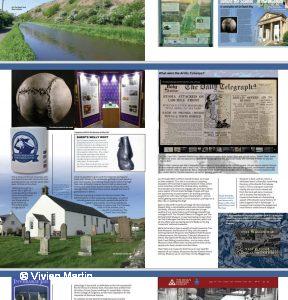
The Falkirk Herald, September 1948
Fortunately, the challenge of a community buy-out is not a new one for the residents of Inverie. Like much of rural Scotland, Knoydart saw continuing depopulation throughout the 19th and 20th centuries. So much so that there was even a suggestion in the 1990s that the peninsula be turned into yet another military training area. However, the community pulled together and in 1999 successfully bought out the old Knoydart Estate. Since then, under the auspices of the Knoydart Foundation, there have been a wealth of positive changes: everything from improved housing, affordable homes, the introduction of a Ranger service, expansion of local enterprises, forestry, a community owned trading company and, very importantly, their own hydro-electric scheme, Knoydart Renewables.

Press&Journal November 1969
Scoraig likewise, saw its population dwindle and almost die out over the years. As with Knoydart, attempts to re-populate and revive the area, particularly after the Second World War, started off with high hopes, only to come to naught because of inequitable land ownership. But Scoraig has survived, thanks in no small measure to an influx of young people in the late 1960s. Although initially greeted with scepticism, they were determined not to be defeated.

Scoraig Heritage Centre!
At the time theirs was labelled a crackpot ‘alternative’ lifestyle. But in reality their approach to crofting and self-sufficiency, along with the harnessing of wind power, was ahead of its time and is now seen as a way forward for the rest of us. So much so, that one of Scoraig’s residents, Hugh Piggott, who helped build many of Scoraig’s original wind-turbines, now writes and teaches on the subject and runs Scoraig Wind Electric.
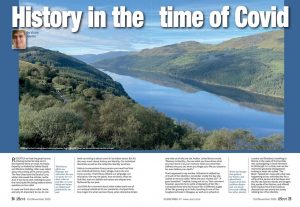
The story of both these communities is a long, and at times depressing one, so out-dated is land ownership in Scotland. But perseverance has paid off and they’re inspirational stories well-worth hearing and that’s what I’ve looked at in some detail in this month’s article in issue 71 of iScot Magazine.


 Without curiosity people wouldn’t explore or experiment. Without curiosity early man wouldn’t have gone to see what was over the next hill or on the other side of that wide blue ocean. Without curiosity scientists and doctors wouldn’t have made the breakthroughs they have. Curiosity fuels our imagination and opens our eyes to connections we hadn’t noticed before. Just think of the complex process required to turn cocoa beans into chocolate and you have to marvel at human ingenuity!
 People have always been curious, trying to find ways – and the words – to understand the world around them. To explain the seasons, the floods and famine, as well as the bounty and beauty of the world. To understand why the world is the way it is.
 Pilgrimage is nothing new: Macbeth, Robert the Bruce and James IV all made pilgrimages. But today there’s a whole new generation looking at the old ways with contemporary eyes. And there are flourishing pilgrim routes all across Scotland and Europe. A modern pilgrim may venture forth for different reasons than those of the past. But that time out, re-connecting with the land, seeking to re-focus on what’s important and what we’re trying to do with our lives, is an experience worth considering. And fortunately Scotland is a country with a wealth of pilgrim routes, enriched by a long history of Celtic and medieval Christianity. So wherever you live, chances are there’s one pretty close to your doorstep!
 There are few things better than a good news story – and this has to be one of the best! When I posted news of my great-aunt’s debut novel on Facebook and Twitter, a novel completed at the age of 97 no less, I could never have foreseen the extraordinary outpouring of congratulations and good wishes it would give rise to. But more than that, there was a huge tide of thanks, and appreciation, from people to whom she has given hope. Her achievement has encouraged so many others.
 I created a new hashtag on social media yesterday, #NonagenarianNovelists. I created it to celebrate the publication of a debut novel written by my amazing 97-year-old great-aunt! Aberdeen-born and Huntly-bred, Tonie Ritchie completed her first novel this year. A great achievement for anyone, let alone a nonagenarian!
 She now lives in Plymouth where she’d returned in 1990 after Jimmy died. She then studied English at GCSE and A Level, before taking up creative writing and having several short stories and poems published.

 I’ve written about these issues before, but feel they’re worth revisiting becau
 In this month’s
  The computer keyboard is getting well worn! From the author of The Peat Dead and The Dead of Jura, comes the first book in a spectacular new series – Death in Tallinn.
 It’s not that long ago that virtual reality was the domain of science fiction writers. The idea of communicating via our computers wasn’t something we took that seriously. But how quickly that’s changed and how quickly we’ve had to adapt to our virtual lives!
 Especially when the technology decides not to play along and you’re faced with a last minute change of plan – and room!
 With good hosting from Thunderpoint’s Seonaid Francis, a good audience, good questions, and good answers from both Allan Martin and fellow crime writer Marion Todd, it was an evening to savour and one that left us with lots to think about. Especially as crime covers such an astonishing array of scenarios: everything from the petty thief to the corporate criminals who do so much damage to so many.
 Chances are Bonfire Night will be a bit of a damp squib this year. But that doesn’t mean the 5th of November is going to be a complete washout. Instead, why not join Allan Martin and bestselling author Marion Todd for the official launch of The Dead of Jura!
 Just how Magnus, from a shed in Dalmally, has managed to create a charity that now feeds well over a million children every day is an extraordinary story. But there’s even more to it than that. For it’s not just food that Mary’s Meals provide. It’s also hope. That meal, given to them each day at school, helps these children get the education they need to get themselves out of poverty. It makes a better future a real possibilty.
  Love Reaches Everywhere, show that books and films really can help change lives.