
 There’s a lot to be said for literary tourism!
Certain books have meant a great deal to me and I’ve enjoyed visiting the places that play a key role in them. Three spring immediately to mind: The Black Isle of Jane Duncan’s novels. Wester Ross and Sutherland of Sheila Stuart’s Alison books. And Ngaio Marsh’s When in Rome, where her suave gentleman detective Roderick Alleyn joins a select group on a murderous tour of a famous church, which was based on the real, very ancient and with an extraordinary archaeological significance, Basilica di San Clemente.
Many different things trigger novelists to write a particular storyline. A conversation overheard on a bus, a dream, a snippet of information on the news – then the writer’s imagination takes over and the process of “What if…?” begins.

Sheila Stuart
But whatever the inspiration for the plot may be, I’m a firm believer that the location, a convincing sense of place, can make a good story even better.
On a visit to Ardtornish in the Morvern Peninsula I discovered that this had been a special place to Scottish novelist John Buchan (1875-1940).
It’s hard to describe Buchan as he was a man of so many parts: a son of the manse, lawyer, novelist, historian, poet, war-correspondent, diplomat, colonial administrator, army intelligence officer at the Western Front and later Director of Intelligence, politician and finally Governor General of Canada. All these and more. But predominantly a man who loved to write.

John Buchan
If you’ve read The 39 Steps, or seen one of the cinema versions, you’ll be familiar with the derring-do of his hero Richard Hannay. And be familiar too with the global, and at times very fanciful, conspiracies and evil-doers of the day.
However, one of his other classic tales, and perhaps a more plausible one, is John Macnab, first published in 1925. It’s a tale of adventure, the story of an unusual challenge taken up by three men, plagued by inertia and depression in the aftermath of the First World War, a time when the world was for very many people a bleak, sad and difficult place.

Andrew Greig
It’s also a book which I feel is worth reading in conjunction with it’s ‘sequel’, The Return of John Macnab, penned by author and poet Andrew Greig in 1996. Both novels revolve round tales of poaching and challenge at a time of personal crisis for their characters.
In Buchan’s John Macnab, it’s three dissatisfied and world-weary establishment figures who take the challenge; in Andrew Greig’s it’s a very different cast of characters, with a strong critique on present-day land ownership in Scotland to boot. Both different, both of their times, and yet they make for an intriguing pairing.
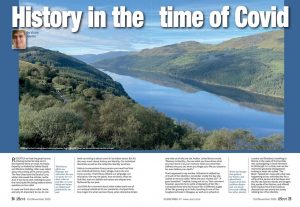
 It was John Buchan’s visits to Ardtornish that shaped the setting and action behind his fictitious tale of John Macnab. And in issue 75 of iScot Magazine, I take a look at Buchan’s time spent there and how this magnificent landscape shaped both him, his imagination and the high adventure of John Macnab.
 Life is seldom static but some changes are much more far-reaching than others. Losing your home and all your possessions, to be left with only the clothes you stand up in, happens to refugees from war-torn countries today. Yet it also happened in the past in Scotland, and the Clearances are a well-documented and grim part of our country’s history.


 Bute’s an island that’s often overlooked. Perhaps because it’s almost too close to the mainland. Or perhaps because people sometimes fail to look beyond the rather tired buildings of Rothesay’s seafront. But, as with most places, there’s definitely more to Bute, and its people, than meets the eye.
 Then, in 1898, he saved the life of young Malcolm McAlpine, son of the civil engineer Robert McAlpine, whose company still exists today. During the building of the West Highland Line extension to Mallaig, a devastating blast shattered that young man’s body and it looked as though nothing could be done to save his life. Yet, they hadn’t reckoned with the skill, dedication and compassion of William Macewen. The young man, who had been at death’s door, not only recovered, but lived to a ripe old age. And the West Highland Line extension was completed on time.
 Macewen was also the man who did so much for wounded soldiers, for those young men who returned with horrific injuries from the hellish battlefields of WW1. He designed the Erskine artificial limb and trained a team of engineers from a nearby shipyard to manufacture them for the newly-founded Erskine hospital. He worked tirelessly both on the mainland and on Bute to help his patients, no matter who they were.

 It’s not been an easy journey for either community. Neither have what we would consider ‘ease of access’, nor, until fairly recently, the opportunity to own the land they live on. However, you may have noticed that Inverie has been in the news again recently with talk


 Without curiosity people wouldn’t explore or experiment. Without curiosity early man wouldn’t have gone to see what was over the next hill or on the other side of that wide blue ocean. Without curiosity scientists and doctors wouldn’t have made the breakthroughs they have. Curiosity fuels our imagination and opens our eyes to connections we hadn’t noticed before. Just think of the complex process required to turn cocoa beans into chocolate and you have to marvel at human ingenuity!
 People have always been curious, trying to find ways – and the words – to understand the world around them. To explain the seasons, the floods and famine, as well as the bounty and beauty of the world. To understand why the world is the way it is.
 Pilgrimage is nothing new: Macbeth, Robert the Bruce and James IV all made pilgrimages. But today there’s a whole new generation looking at the old ways with contemporary eyes. And there are flourishing pilgrim routes all across Scotland and Europe. A modern pilgrim may venture forth for different reasons than those of the past. But that time out, re-connecting with the land, seeking to re-focus on what’s important and what we’re trying to do with our lives, is an experience worth considering. And fortunately Scotland is a country with a wealth of pilgrim routes, enriched by a long history of Celtic and medieval Christianity. So wherever you live, chances are there’s one pretty close to your doorstep!
 I’ve written about these issues before, but feel they’re worth revisiting becau
 In this month’s
 Just how Magnus, from a shed in Dalmally, has managed to create a charity that now feeds well over a million children every day is an extraordinary story. But there’s even more to it than that. For it’s not just food that Mary’s Meals provide. It’s also hope. That meal, given to them each day at school, helps these children get the education they need to get themselves out of poverty. It makes a better future a real possibilty.
  Love Reaches Everywhere, show that books and films really can help change lives.


 In the current issue of iScot magazine I take a look at the story behind the lives of the people of Torridon both past and present. At the challenges faced both then and now. And how we owe a great deal to those who went before us. It’s a fascinating area and though remote, there’s much more to it than you might at first believe.