 … as well as being great for making Gorse Flower Tea, can also be used to make the most delicious Gorse Flower Cordial, or Gorse Flower Syrup, or Gorse Flower Wine.
So get out and get picking!

… as well as being great for making Gorse Flower Tea, can also be used to make the most delicious Gorse Flower Cordial, or Gorse Flower Syrup, or Gorse Flower Wine.
So get out and get picking!

Glorious gorse
You know Spring has arrived when you walk past a gorse bush and the air is full of that delicious aroma of coconut rising from the yellow flowers in the warm sunshine. And right now the Island of Arran is positively awash with gorse.
Gorse, also known as whin or furze, is native to Scotland and has proved its usefulness over the centuries. A traditional winter feed for cattle and other livestock, it would be ground with mallets or with a whin-stone, until it reached an edible consitency!
You can add the flowers to a salad or use the leaf buds to make ‘tea’. Apparently the seeds are mildly astringent, containing tannin, and were used to treat diarrhoea, varicose veins and slow down infections. Then, like most plants, it can be used to produce a dye (replace the The Good Life’s nettle green with yellow!)

Goats love gorse!
Importantly, it was regularly used as a fuel, burning well even when quite green because of its high oil content. The ashes are rich in alkali and gorse was often burned off to improve the quality of the land. These alkali-rich ashes were also mixed with animal fat to make soap. And it’s a sanctuary for small birds, who can hide safely inside this thorny shrub.
On the other hand, there are few things worse than fighting your way through gorse that has been allowed to grow unchecked – then those spikes become just too vicious. But, on the whole, gorse has been a friend to farmers and crofters and fitted in well with rural life in this country.

Skunk cabbage fringes the pond at Brodick Castle

Gunnera aka ‘giant rhubarb’!
Unfortunately the same can’t be said of the rampant rhododendrons that grow unchecked in so many parts of Scotland. In the right setting, as in the gardens of Brodick Castle, rhododendrons flourish alongside other exotic plants that were brought here in the late 18th and 19th centuries to fill the gardens of the new, fashion-conscious, owners of country houses. In Brodick Castle grounds you’ll see American skunk cabbage (with its very curious smell) and Gunnera (looking for all the world like enormous rhubarb) arranged to create areas of great interest.
However, as the management of many large country estates has declined, their gardens have been left to run wild. As a result, some of these non-native species have been allowed to escape and are now too rampant, too invasive, and are causing wide-spread difficulties. In particular that ‘Victorian monster’ Rhododendron ponticum, has become a severe problem throughout Scotland. It shades out other plants – and their attendant wildlife – and soon creates dense jungles which are not simply hard work, but also almost impossible, to clear.
There a numerous projects afoot now to try and contain and clear these plants which are deadly to all other growth if left unchecked. Though I would have to say that the relatively new-kid-on-the-block, Japanese Knotweed, is now regarded as the world’s most invasive species. It’s found a foothold here and is spreading, and any plant that can grow up through concrete floors and bring down houses is definitely a real menace!
Give me gorse spikes (and a pair of secateurs) any day!!

A bank of gorse protects the grass and sand dunes along the shore at Brodick Bay
 It’s genuinely remote, there are plenty of obstacles to getting there, but it can be done – and it’s definitely worth it! Time of year, weather and MOD activity in the bombardment range, all have to be taken into consideration before you set out. Once these factors are sorted, however, you’re on your way. And fear not – there will be a cup of tea waiting for you when you finally reach the lighthouse!
We felt a real sense of achievement when we visited Cape Wrath. There’s the lighthouse and the welcome Ozone Cafe, as well as the decaying Lloyds Buildings, which are described on the Visit Cape Wrath website as: “a signalling station complex established by Lloyd’s of London Marine and Commercial Insurers to monitor passing ships, tracking their cargos, ports of departure and destination along with estimated arrival times”. Built between 1894 and 1903, advances in communications led to their closure in 1932, although they were reused at the start of World War II as a coastguard station.
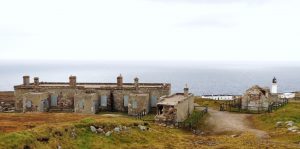
The decaying Lloyds Buildings, closed in 1932
The small group who travelled on the ferry and minibus with us were from all corners of the globe. There’s obviously something very addictive about getting to the (almost) unreachable parts of the world!
I’ve written an article describing the journey and the history of the Cape – from the terrifying arrival of the Vikings – those fearsome Sons of Death – through the trials and tribulations of the Clearances, to the present day set-up where the MOD own vast tracks of the land. The article is available in the April edition of the excellent iScot magazine. iScot is a wide-ranging publication, which looks at what’s happening in Scotland today: what’s going on in the news and what there is to see, do and think about in this wonderful country of ours. If you have an interest in Scotland it’s well worth considering a subscription, whether in paper form or in a digital edition.
 Cape Wrath was the hvarf, the ‘turning point’ for the Vikings. Life is full of turning points and our reactions to these can have a profound effect on how we live our lives and relate to those around us. At times life can be more challenging than we might prefer, but, with places like Cape Wrath to visit, at least we can’t complain that it’s dull!
 Caves full of bones? Mass murder in the peaceful Highlands of Scotland? No, not in this case! But rather a tale of how some things in nature are undoubtedly stranger than fiction!
I’m not a mountaineer, but I delight in the splendour of these ancient hills and glens and find myself amazed at the thought that they were once shared with bears, lynx, arctic lemmings, reindeer and even polar bears! It’s good to know that animals and men roamed freely here for thousands of years, in a landscape, wild and untamed.

It’s a rich and fascinating story of how landscape is shaped and how man fits into that pattern. And how even old bones can tell us so much about our long-ago past.
To find out more, follow the link below for a free download of the March edition of the excellent iScot magazine. And once you’ve read my article about the Bone Caves of Inchnadamph, you’ll be packing a bag and heading off to Assynt to see them for yourselves!
iScot Magazine FREE March download with The Bone Caves of Inchnadamph

 It was freezing cold, with snow in the air and on the hills, and colder the higher we went. But, as so often when walking in Scotland, we knew the destination would be worth it. And that destination was the Loch Sloy dam, flanked by the mighty and rugged Ben Vorlich.
Parking at Inveruglas Visitor Centre on the west bank of Loch Lomond, we followed the signposts for Loch Sloy & Hills, which took us past the impressive Loch Sloy Hydro-Electric power station. Construction of the dam began in May 1945 and was the first in the North of Scotland Hydro-Electric Board’s revolutionary scheme. Work was completed in 1949 and the station officially ‘switched on’ in October 1950. The construction work was back-breaking and dangerous, with twenty-one men losing their lives in the process.

Loch Sloy Hydro-Electric station on Loch Lomond
The dramatic history of ‘Power from the Glens’ has long interested me. The water for this power station comes from Loch Sloy, high in the hills, with its massive dam, 56 metres high and 357 metres long. From here it is channelled through a 3km tunnel, hewn through of the massive side of Ben Vorlich. On reaching the valve house it thunders down through four mammoth pipes to drive the turbines below. Such is the power of the water that the station can generate enough electricity to meet sudden peaks in demand, reaching full-capacity within 5 minutes of a standing start!
It’s a straightforward walk, a round-trip of 11km. When you reach the access road to the dam, walk under the railway bridge and then it’s up! And the higher you go, the better the views of Loch Lomond and the surrounding hills become. The construction of the Loch Sloy dam and power station was, quite literally, a groundbreaking start to one of the most progressive and far-reaching engineering projects in the world. So when you reach the dam, take a look at your map, and wonder at how it was possible, all those years ago, to carve such tunnels through these mountains. Some of the work force were even prisoners-of-war awaiting repatriation. In a booklet published by Scottish Hydro Electric, due credit is given to these men:
 “After the Second World War, men from all over Scotland came to work on the schemes, attracted by high wages. The highest wages were earned by the men who dug the tunnels. Germans, Poles and Czechs were acknowledged to be skilled tunnellers. They became known as the ‘Tunnel Tigers’ because of their cavalier approach to safety in their quest to earn the huge bonuses that were available. The lower regard for health and safety issues than there is today inevitably led to high accident rates and deaths amongst the workers. No definitive accident statistics exist, but in one camp alone, which housed some 1,000 workers at its peak, there were 22 deaths in just one year. For the vast majority of workers the rewards were great. In the late 1940s, a ‘Tunnel Tiger’ could expect to earn up to £35 a week, compared to £3 or £4 for a Highland estate worker. Mostly they lived in temporary work camps built near the construction sites. Not surprisingly, the sites looked like military camps, sometimes housing up to 3,000 men.”

The scheme was masterminded by Scottish politician Tom Johnston (1881-1965) and, under the auspices of the North of Scotland Hydro-Electric Scheme, succeeded in bringing power to the glens in a way never before imaginable. By 1963 90% of the Highlands were attached to the grid, more than twice as many as when the scheme began just after the Second World War. ‘Power from the Glens’ ultimately changed the face of rural Scotland and the benefits continue to this day.
Their achievements are all the more remarkable given the harsh conditions and often unforgiving terrain they had to work in, and we owe them a great deal. For not only is Scotland a country of great natural beauty, but it’s also one rich in natural resources. And so it’s doubly remarkable that Tom Johnston and his fellow visionaries harnessed hydro-power without damaging the landscape, and also left dams and power stations of great stature and beauty.
As renewable and sustainable energy become increasingly important, the hydro-power schemes these men bequeathed us become equally more significant. We need renewable energy like hydro-power: and in a country of rivers, lochs and plentiful rain, hydro-power is definitely here to stay!

Snow- and cloud-capped Ben Lomond from the road to Loch Sloy dam

The LookOut mirrored cabin on the shores of Loch Voil and Loch Doine
On a dreich day in February getting out-of-doors might not be uppermost in your mind! On the other hand, it can be a time to think about, and plan for, trips in the not-too-distant future. A favourite place of mine is one of the innovative Scenic Routes installations in Loch Lomond & The Trossachs National Park: The LookOut on Loch Voil.
Strictly speaking, it’s not on Loch Voil, but sits in a flat meadow between the head of Loch Voil and its smaller neighbour, Loch Doine. Here the stretch of water between the two lochs is so short and narrow that the south bank is barely yards away and accessible by stepping stones for the brave!

Even the puddles are reflected in the LookOut cabin!
To reach the LookOut you follow the twisting single-track road that runs through Balquhidder Glen along the beautiful north shore of Loch Voil, until you come to Monachyle Mhor farm restaurant and hotel, where you can leave your car and walk down to the shore.
The LookOut is a Tardis-like mirrored cabin, that reflects different views of the landscape in which it stands. Depending on the light, it can be almost invisible as it blends in with the surrounding meadow, hills and lochs: so much so that it can be easy to miss, only to come as a surprise as you begin to see yourself approaching! In a curious way it can make you feel that you’re part of this beautiful landscape.
Balquhidder is also on the BLiSS (Balqhuidder, Lochearnhead, Strathyre and St Fillans) Trail: a community extension of the Scottish Scenic Routes project. Gordon Watson, Chief Executive, Loch Lomond & The Trossachs National Park welcomed BLiSS, saying: ” I wanted to say how impressed I am at your efforts to extend the success of the Scottish Scenic Routes initiative through the launch of the BLiSS Trail. I was delighted to see the coverage that the launch attracted. Your dedication to improving the visitor experience in the area is a real credit to the National Park, so thank you.”

Monachyle Mhor farm restaurant and hotel
The BLiSS Trail is in Rob Roy Country and it’s hard to miss that Balquhidder Glen is very much MacGregor territory! On the approach to Loch Voil you come through the village of Balquidder, with its tiny church and the graves of Rob Roy and his family. While across the water from the LookOut is Monachyle Tuarach, a working farm and a comfortable hostel today, but once home to Rob and his wife before his final move in 1722 to Inverlochlarig, at the head of the glen, where he lived peaceably until his death in 1734.
If you’re feeling adventurous, it’s possible to drive to the end of the public road at Inverlochlarig, where there is a small car park and picnic area, and from here you can take to the hills! But what is a dead-end to us today was once the ‘Coffin Road’ from Glen Falloch to Balquidder Kirk. Take a look at a map and find Bealach nan Corp – Pass of the Corpses – and it’s amazing to think that coffins were carried for such a distance and over such wild and high terrain as this.

The road along Balquhidder Glen
Balquhidder Glen had long been of spiritual importance and legend has it that St Angus, who brought Christianity to the area in the 8th century, recognised it as a “thin place”, a spot, the Celts believed, where Earth and Heaven, the earthly and the spiritual, are very close.
St Angus is said to have spent the rest of his life in Balquhidder and to be buried somewhere near the site of the original first church there: Eaglais Beag, the Little Church. Clach Aonghais, the Angus Stone, which once covered his grave, can today be found in the church.

Looking down Loch Doine
So, if you’ve not yet been to the LookOut, or followed the BLiSS Trail, put them firmly on your to-visit-list. And when you reach the LookOut, make sure you take a photo of yourself reflected in its mirrors. Designed by Daniel Tyler and Angus Ritchie, this scenic viewpoint is one that, quite literally, puts you in the picture!
 iScot magazine have a special free download offer this month. Among many other interesting items, it contains an article I’ve written about the wonderful West Island Way walking trail on the island of Bute. https://pocketmags.com/iscot-magazine
You can also read about Robert Burns, the remote but beautiful Applecross Peninsula, Kelvingrove Museum and Art Gallery, current affairs, whisky, the dreaded midge, Meal Makers (help for the elderly) and much more.
And if you love the great outdoors here’s a new website devoted to Argyll: http://www.wildaboutargyll.co.uk/ Watch the short film and see how many of these places you have already been to – and then visit the rest!
There’s something for everyone in Scotland!
 I have a good friend, for whom the sight of a robin is a reminder of her much-loved and much-missed mother. Seeing a robin flit by is always a welcome sight for her. A reassurance. A tiny living prayer.
It made me wonder why certain birds and animals have acquired a particular significance. Harbingers of good – or bad – luck. It could be a black cat crossing your path. Rabbits and their feet. Magpies with ‘One for sorrow, two for joy…’ And there are many more. Today robins have a strong association with Christmas and even a cursory glance at a pile of Christmas cards will reveal many picturing bright little robins. What brought this about?
One story I read tells of the very first Christmas when a robin was bravely fanning the dying embers of the fire in the stable where the infant Jesus lay sleeping. If the fire went out the child would be chilled. The robin didn’t give up, but gathered twigs to keep the fire alight. A hot spark leapt from the fire and the little robin’s breast was burnt red. When Mary returned she blessed the robin for his care of her baby son, and for his bravery. From then on all robins carried a redbreast, a proud reminder of their generous act. And thus began their close association with Christmas.
Another legend tells of a robin trying to ease Jesus’ pain at the crucifixion by removing one of the vicious barbs from the crown of thorns. Some of Christ’s blood splashed onto the robin’s breast, again to become a permanent marker of the little bird’s bravery and compassion.
More mundane perhaps, is the story that Victorian postmen, clad in their bright red jackets, became known as ‘robin redbreasts’ and before long a robin appeared on an early Christmas card. Christmas cards were a new idea in the mid-19th century and rapidly became very popular. The robin has had pride of place there ever since!
One curious fact I discovered: look closely and you’ll see that a robin’s breast is orange, rather than red. It seems that the colour we know as orange today – named from the fruit – didn’t exist in the English language until the 16th century and wasn’t used as a distinct colour name until much later. ‘Robin Orangebreast’ doesn’t sound quite the same, though, and definitely lacks alliterative appeal!
But however their name, or their connection with Christmas, really came about, they are bright-eyed, intelligent, engaging little birds. Gardeners know that as soon as you turn the soil a robin will be there watching you closely, following your movements on the lookout for food in the disturbed earth. I find it a great pleasure to see these delightful creatures in my garden, or wherever I am outdoors. And the notion of their being a tiny living prayer is one I’m more than happy to go along with. Especially at Christmas.

If you know Bute, you’ll know the long, steep, twisting road that’s very appropriately called the Serpentine. It’s a favourite challenge with cycling enthusiasts, who test their mettle tackling the 13 hairpin bends to get to the top. Today we’re sitting in a flat halfway up this precipitous road with a spectacular view right over Rothesay Bay and beyond. From here we can see the Calmac ferry making its final turn to berth at the pier, bringing both residents and visitors to this popular island in the Firth of Clyde. With its gleaming white superstructure and red and black funnels, emblazoned with the company’s insignia, the ferry is a vivid and welcome sight – no matter how often you may have seen it before.
We’re here for a few days holiday – though rest and recuperation would be a more accurate description. My husband almost lost his life a short while ago and even though he’s recovering well, and so very grateful to be alive, it still takes time to come to terms with an event that could have changed our lives forever.
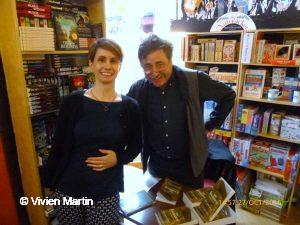
Karen Latto and Prof Richard Smith
It felt like more than a coincidence when we discovered that Print Point, the island’s fine bookshop, was hosting a visit from eminent gynaecological surgeon and cancer specialist J Richard Smith. Richard’s new book – The Journey – is an account of the author’s own brush with ‘the reality of mortality’, as well as examining the physical and psychological challenges faced by recovering patients. You might think that recovery from a life-threatening illness, or accident, would leave you ready to carry on with life as before, but in fact, he told us, people often fall into one of two categories. There are those who recover and have a heightened sense of being given a second chance and endeavour to live each day to the full. But, sadly, there are others who find themselves sinking into a state of dread, so anxious are they that the illness might recur that they become unable to live life meaningfully, and become prisoners of their own fears.
Like most people, I’d heard it said that, if you fall off a horse you should get back on one again as soon as possible before you find yourself too scared to do so. But I hadn’t thought of this in connection with major illnesses and accidents.
I do now.
Unbidden and unwelcome comes the thought that if it could happen once it could happen again. And how do you deal with that?
Richard Smith’s book suggests one way. With his many years experience working with patients who are at their most vulnerable, physically as well as psychologically, The Journey (subtitled Spirituality, Pilgrimage and Chant) maps Richard’s own ‘pilgrimage’, his journeys of discovery. He writes of the road he has travelled towards physical and spiritual wellbeing; “of the challenges and wonders of pilgrim paths to ancient sites such as Jerusalem, Assisi, Iona, Patmos and Mount Athos… The Journey is a book about being whole and is for anyone on the pathway to physical healing after illness, or seeking greater spiritual fulfillment.”

Old Man’s Beard lichen – sign of healthy, clean air
Right now we feel such gratitude that we’ve been given that second chance and are learning to overcome the fears that inevitably accompany it. I hope the path we chose is the one where we continue to live life with relish and make the most of each day as it comes.
Reading Richard’s book, being back on Bute, having the support of friends; these all contribute to the ongoing process of recovery. And I’m grateful for all of them.
 “A CAMPING COACH. Another recent form of holiday-making by rail is in the camping coach. These coaches stand in some remote, rural siding and come under the care of the local station-master.” (From Railway Wonders of the World, April 1935)
Can you imagine how exciting it must have been for children to have their very own railway carriage to live in? In the summer of 1963 we had just that, and had one of the best family holidays ever! A converted railway carriage that sat on a siding beside the station at Plockton. Perfect accommodation set in a stunning location on the north-west coast of Scotland.
The carriage was fitted out with a kitchen, living and dining area and three ‘bedrooms’. The only thing lacking was a toilet, but we were free to use the station toilet, with ‘potties’ to hand for young children in the night!
In those days Plockton, a Highland village on the shores of Loch Carron, had yet to acquire fame as the fictional home of PC Hamish Macbeth (and who can forget Robert Carlyle in the role?). But it was definitely well-known as a wonderful place to spend the summer. Close to sea, loch, hill and glen.
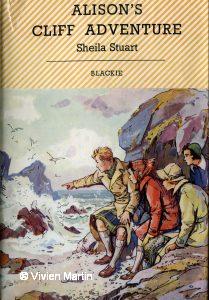
As children growing up with books like Swallows and Amazons, the Famous Five and Sheila Stuart’s Alison books, there couldn’t have been a more perfect a place for a holiday. We were ready to swim, row, fish, cycle, explore caves, find treasure, climb trees, scale cliffs, foil dastardly crooks: in short, we were ready for adventure! And while the Famous Five might have had their own island and lighthouse, we felt we were doing just as well spending the long summer holidays in a railway carriage!
Why camping coaches? The first coaches made their appearance in the 1930s at a time when cycling, hiking and camping were becoming increasingly popular among Britain’s urban population. Very many people still lived crammed into the grimy, heavily-industrialised cities, where pollution, in particular smog, was a problem.
We might think that smog was only a problem in late Victorian times; a useful cover for criminals in Arthur Conan Doyle’s Sherlock Holmes stories, or the infamous and creepy pea-soupers of old black and white films watched on wet Sunday afternoons. But in reality smog was deadly problem long after that. In fact, as late as 1952 the Great Smog in London is believed to have caused up to 12,000 deaths and ultimately prompted the 1956 Clean Air Act.
 As holidays became more common, and for longer periods, people sought the fresh, clean air of the countryside. For families with children camping coaches held a greater appeal than spending your holiday under canvas. In the railway coach you had a proper roof over your head and more space, but were still away from home. They were also usually set beside beautiful remote rural and coastal areas of Britain. Cheaper too than a guest house. Private cars were not common, so being able to take the train right to your holiday doorstep was an additional bonus.
World War II saw the coaches taken out of service, but for two decades after the war they flourished again, better equipped and more luxurious than before. Till along came Richard Beeching with his axe: lines were closed, stations closed and many of the most popular camping coach sites disappeared. Cheap flights and holidays in the sun also played their part in ending this unique type of holiday.
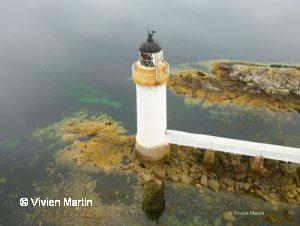 The camping coach at Plockton may be long gone, but today the station building itself is available for holidays. And in a few places the camping coach is making a come-back. So if you have fond memories from your childhood, or have children who revel in Thomas the Tank Engine, then one of today’s new camping coaches might just be the place for you! It certainly was a brilliant ‘Camping Coach of Adventure’ for us !