Inchcailloch: “A part of the world and a world of its own”

“Nights and days came and passed, and summer and winter and the rain. And it was good to be a little Island. A part of the world and a world of its own, all surrounded by the bright blue sea.”
― Margaret Wise Brown, The Little Island

The Margaret at the landing stage on Inchcailloch with Conic Hill and the West Highland Way beyond

It’s little more than a ditty, but Margaret Brown’s poem sums up beautifully what it means to be an island: “A part of the world and a world of its own.” I suspect that also sums up the way many of us feel at times! An island offers that bit of distance, that apartness that we often need to slow down and deal with all that goes on in our busy, and all-too-often fraught, lives.

I’m fortunate to live on the West Coast of Scotland and have islands all around. This week my son and I drove to Balmaha on the east bank of Loch Lomond, where we had lunch in the delightful Oak Tree Inn. We then took the little mail boat from Macfarlane’s Boatyard over to Inchcailloch. The ferry, the 1947 30′ long Margaret, plies back and forth throughout the day taking visitors to and from the jetty at North Bay on Inchcailloch. It’s only a few minutes sail away, but as soon as you step ashore realise that you’re in a different world.

Welcome to Inchcailloch!

Up the steep and twisting stone steps and then through the woods we went. Oak trees abound here, providing a rich habitat for animals and plants. Alders too, those water-loving trees that thrive in damp conditions and help fight erosion. Rowans, or Mountain Ash, are there in plenty as well. With their rich red berries they were believed to have magical properties for combatting evil and were often planted beside cottage doors to ward off malign spirits.

The sun shone through the trees and dappled the path in front of us. Our first stop was the old burial ground, where ‘saints and sinners’ alike lie buried. The island’s original Gaelic name is Innis Caillich, which means the Isle of the Old Women, or Cowled Women (ie nuns). This ties in with the tradition that St Kentigerna, the daughter of an Irish King, settled on the island and then established a nunnery here. She is believed to have died in 733 AD.

With such sacred associations the island became home to a 12th century chapel dedicated to St Kentigerna’s memory, with a later parish church and burial ground used by people living in the small scattered communities around the shores of Loch Lomond. Islands were often favoured spots for graveyards as they were safe from scavenging wolves and other wild animals that might be on the lookout for fresh bones! So far, the earliest gravestone discovered dates back to the 13th century.

Digitalis or Foxgloves

Before there was a pier at the North Bay, boats beached on the shore below Ballach an Eoin, the Gaelic for Pass of the Birds. Almost everthing that arrived on the island, or was transported from it, came this way, and that included the coffins for burial in the graveyard. It’s not unusual to find Coffin Roads or Coffin Glens in Scotland, and this was one of them.

Over the centuries Inchcailloch was many things: a hunting ground for kings and queens, where deer could roam safely away from predators (other than human ones!): while for centuries there was farming on the island until the landowner ended agriculture in favour of the (for him) more profitable planting of oak trees, which became important as a rich source of timber and bark for tanning.

Today it’s a peaceful place, carefully managed by Loch Lomond & the Trossachs National Park, there for both people and nature to enjoy.  And this little “world of its own” is just waiting for you to come and visit!


Useful Links:

Loch Lomond & Trossachs National Park

Balmaha Boatyard

Oak Tree Inn

Scotland’s Wild, Tours of Loch Lomond and the Trossachs

 Camping on Inchcailloch

“There’s been a murder…!” Bute Noir Investigated

Mass murders approach the unsuspecting citizens of Bute!Last weekend the Isle of Bute basked in sunshine, its worthy citizens little realising that a ferry-load of mass murderers, psychopaths and serial killers (both male and female) were about to set foot on their beloved island: unaware that a gang of killers was about to hit the streets of Rothesay, the capital of this peaceful west coast island.

From California to Govan they came, each with their own unique and perfected methods of murder. Each with their own preferences for death and carnage. But thankfully on this occasion no blood would be spilt, for these desperadoes kill not with daggers or guns, but with the pen!

Californian Alexandra Sokoloff and Glaswegian Chris Brookmyre get to grips with hard questions from the audience in Rothesay Library

Thus it was that journalist-turned-crime-writier Craig Robertson and his band of Tartan Noir friends arrived on the island for the first ever Bute Noir crime writing festival and what a success it was!

Organised jointly by Craig, along with Karen Latto of Print Point (Rothesay’s wonderful bookshop) and the library’s Patricia MacArthur, the talks were hosted across three venues: by Karen at Print Point, by Kevin Baker at Rothesay Library and by Anne Spiers at Bute Museum.

Library staff kept us all fed and watered!

The topics ranged from the serious to the comic – from the grim reality that lies behind much of crime writing, to “squirrels on steroids, heads in fridges and the perfect writing paper…!” to quote the island’s newspaper, The Buteman.

The visiting authors looked at what lies behind the personalities of serial killers; discussed the way different women approach crime writing (‘Deadlier than the Male?’);  debated the extent to which locations add to the realism of a novel; talked about the writing of the ‘cosy’ crime novels that many readers also appreciate; then brought the festival to a hilarious finale with a ‘Question of Court’, when Chris Brookmyre, Luca Veste and Michael J. Malone pitted their wits and literary knowledge against the sharp minds of Caro Ramsay, Douglas Skelton and G.J.Brown.

Prepare to be afraid, very afraid!

Prepare to be afraid, very afraid!

The island played its part too as the Bute Noir programmes and posters all featured the atmospheric and eerie photograph of the road to the Dhu Loch, taken by talented Bute photographer John Williams. The evocative image of a dark and winding road through trees, leading to an unknown and mysterious destination, was just the thing to get your imagination going and send a shiver or two down your spine!

This inaugural Bute Noir was a good mix of gentler crime, alongside police procedurals and the darker Tartan Noir: with a slice of the mysterious and the supernatural thrown in as well. The turnout for all the events showed just how much interest there is in all aspects of the process of writing – from the original spark of an idea to the final published book.

Chris Brookmyre, Luca Veste, Michael J. Malone, quizmaster Craig Robertson, Caro Ramsay and Douglas Skelton get reay for a trial of wits in a 'Question of Court'

Chris Brookmyre, Luca Veste, Michael J. Malone, quizmaster Craig Robertson, Caro Ramsay and Douglas Skelton get ready for a trial of wits in a ‘Question of Court’

All in all, a great success and if you missed meeting these dealers in death this time round: fear not – They’ll be back!!

**********************************************

Find out more at:

How unique is Scottish Crime Fiction by Allan Martin

Bute Museum

Estonia: Flying the flag – or how traditions can save a nation (Part 3)

St Andrew’s Cross – the Saltire – seen in the sky!

Sometimes, on a clear sunny day when the sky is blue, the vapour trails from jets flying high overhead can leave a beautiful image of the Saltire, Scotland’s national flag.  The Saltire is believed to be one of the oldest national flags in the world and although no-one knows for certain how it came to be chosen, tradition has it that in AD 832 an army of Picts under King Óengus (Angus), with support from Dalriadan Scots, found themselves surrounded and outnumbered by Angles.

The Flag Heritage Centre at Athelstaneford

Things looked bad and Angus prayed for divine help: to his amazement the clouds formed a white Saltire against the blue sky and the Picts and Scots won the battle.  St Andrew became the patron saint of Scotland and the Saltire, St Andrew’s Cross, became our flag.

In the East Lothian village of Athelstaneford – where that momentous battle is believed to have taken place – the Scottish Flag Trust run the Flag Heritage Centre where the story of Scotland’s flag is told.

St Mary’s Church in Otepää

When we were back in Estonia in May of this year, we visited Otepää, a ski resort in southern Estonia, the country’s ‘winter capital’. There we discovered that, like Athelstaneford in Scotland, Otepää had played an important part in the history of the national flag of Estonia. In St Mary’s Lutheran Church we heard how the blue, black and white – the sinimustvalge – of Estonia’s flag came from the three colours in the caps worn by Tartu University students in the 19th century: and that these three colours were also used in the Estonian Student Union flag.

It was this flag that was consecrated in St Mary’s Church in 1884 to become the national flag of the whole country.  In 1918, when the Estonian Republic was established, these three colours  became the new republic’s official national colours.  Then in 1991, when Estonia once again regained its independence,  it became the official flag of the the Republic of Estonia.

Traditional Estonian student caps at Tartu University

Otepää is home to the Estonian Flag Room which was established in 1996 to commemorate their flag – a flag that is as important to Estonians as the Saltire is to Scots. In fact, it was a delight to see so many Estonian flags being carried and waved with pride at Laulupidu, the Song Festival the previous year: not waved in anger, or superiority – but as a natural part of their lives : this is my land and I love it!

Today, November 30th, is St Andrew’s Day and is celebrated by Scots the world over. Celebrated as a mark of respect for our country and its long history. Celebrated as a sign of our shared heritage and identity. Celebrated to mark all that is good about Scotland. Almost every other country in the world celebrates their homeland in a similar way.

Bas-relief at St Mary’s Church celebrating the consecration of the flag in 1884

Symbols are important. Identity is important. Knowing where you belong, and why, is important. Sadly some people deliberately attempt to equate national pride with imperialism or xenophobia. A foolish mistake. For there is no doubt at all that it’s good to know who we are and what we believe in. It’s good to know about our past and to understand – and value – the struggles of all the ordinary people that have brought us to the point we are at now: though it can also be daunting to know that we have to play our part in these difficult times if we are to ensure that our country continues to grow and develop in a way that is good for all its citizens and not just the few.

Flags are wonderful symbols and I will be celebrating St Andrew’s Day this evening. But I’ll be celebrating Scotland every other day of the year as well!

The Flag Room in Otepää

The Flag Heritage Centre

The Estonian Flag Room in Otepää

 Laulupidu

Estonia: The Magic of Laulupidu – or how traditions can save a nation (Part 2)

Choirs gather in Tallinn from all over Estonia and beyond

Music and song play a great part in life in Scotland. We have a long and rich tradition of songs that reflect all aspects of life in this country. We grow up hearing the profound message in Robert Burns’ A Man’s a Man for A’ That, sung so movingly by Sheena Wellington at the opening of the Scottish Parliament in 1999.   Or For Auld Lang Syne, arguably the most-played and best-known song in the world. We have songs that talk of the common humanity we all share, despite the fact that it’s still very much an ill-divided world.

The procession from Tallinn to the Song Festival Grounds lasted for hours!

There are also songs of anger and frustration that the greed and corruption of the few can make life a misery for so many. Songs that are full of history and the tragedy that is man’s inhumanity to man. But again there are songs like Dougie MacLean’s heartfelt Caledonia, that celebrate the beauty of our landscape and our love for our country. Songs full of longing for justice and equality, for love, for basic human kindness. Songs that reflect the past and future hopes our nation.  Songs that add to what it means to be Scottish.

Beautiful traditional costumes

I was both intrigued and delighted when I discovered that music and song play a huge part in the life of the Baltic nation of Estonia, especially the song festivals that kept their culture and identity alive during centuries of foreign occupation. A few years ago a friend gave me a copy of a documentary called The Singing Revolution, made by a Canadian/Estonian couple, James and Maureen Tusty.  It’s perhaps one of the most moving films I have ever seen and tells of the brave and peaceful struggle by the people of Estonia to be free of the Soviet Union.  And, amazingly, how that long-standing tradition of music and song helped make the revolution possible.

The flame lit, Laulupidu could begin

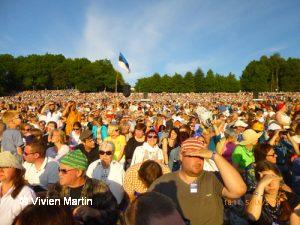
This national Song Festival – Laulupidu – takes place once every five years, so when we returned to Estonia in 2014 we made sure we had tickets – and it’s an event I’ll never forget. Seeing people of all ages, from all over Estonia and beyond, descend on Tallinn in a breathtaking array of costumes was unforgettable. Then there was the patience of more than 25,000 singers as they waited in the blistering July heat to take their places in the opening procession from the heart of Tallinn to the song festival grounds.  Throughout the whole weekend the atmosphere was one of celebration, thankfulness, fun and friendship: hundreds of thousands of people and barely a policeman or security guard in sight – nor any mess either!

100,000 people undeterred by the blistering July heat!

The singing was a mix of old and new songs – songs from the early days of the song festivals as well as by musicians and composers who had lived through the Singing Revolution themselves.  It’s almost impossible to decide on a favourite song, but two that I particularly enjoyed were Rein Rannap’s Ilus Maa (Beautiful Land) and René Eespere’s Ärkamise Aeg (Time of Awakening): both with a hymn-like quality and performed with real conviction and sincerity by almost 30,000 singers on the stage – feelings echoed by 80,000 more in the audience.

More than 25,000 singers take to the stage!

The pride in country and history that the people of Estonia wear so naturally is something we can all learn from: a nation that has no desire to force others to be like them, but instead celebrates the  joy of finally being able to be themselves.  Something that is so important to all people.

History never stands still.  Empires come and go. We bring up our children to become free and independent people, not eternally dependent on us.  Over and over again history shows us that peoples and nations – on every continent in the world – reach a point when it’s time for them to be free to make their own decisions about how their country is governed and how it treats its citizens.

A child steps out confidently, secure in her future thanks to her past

For me, what Estonia achieved – and how it achieved it – is something to be remembered and cherished: and is an example to us all as to how, no matter how long it may take,  lasting change can be made.

Links: The Singing Revolution 

The Singing Revolution: trailer

Ilus Maa (song)

Ärkamise Aeg (song)

The Corries sing A Man’s a Man for A’That

Estonia: The mysteries of Kihnu Troi – or how traditions can save a nation (Part 1)

Underway! Knitting mittens from a traditional Kihnu island pattern

Kihnu Troi – it sounds like a character from a Star Wars film, but is in fact a very distinctive style of Estonian men’s sweater with a unique two-colour braided cast-on!  Kihnu (the ‘h’ is sounded) is an island lying in the Gulf of Riga, Troi their famous traditional knitwear originally worn by the men of this fishing community.

Like exquisite Shetland lace, or Fair Isle sweaters, each region of Estonia has its own unique, intricate and colourful designs. Socks, mittens, jumpers; all as bright and hard-wearing as anything we have in Scotland. Kihnu patterns use black and white wool, with contrasting red bands around hems, cuffs and necks: bands that were believed to grant protection to the wearer.   Knitted from very fine wool, all these garments can last for more than a lifetime.

The powerful medieval Bishop’s Castle on the island of Saaremaa

Estonia’s geographical position has had a profound influence on its turbulent history. Being flat and fertile this small country has found itself repeatedly in the path of invading empires: from ferocious Viking raiders to German, Danish, Swedish, Russian, Nazi and Soviet occupations. It’s a country that has certainly experienced more than its fair share of history!

I’ve visited Estonia a number of times now.  Like Scotland, it’s a country with many islands around its coast, and while geographically different from Scotland (unlike Scotland Estonia is very flat), the inhabitants of these Baltic islands have experienced harsh and difficult conditions that have influenced their lives just as much as times of great hardship have shaped the character of Scotland’s island communities.

But trials and tribulation can breed determination and resilience. Difficulties are overcome and life goes on.  In 1991 Estonia regained its independence from the Soviet Union and the road to recovery began.  Huge changes had to be faced politically and economically, but face them they did.

Suitsuräime – smoked herring Estonian style on the island of Muhu

As in Scotland, the days of the great fleets of trawlers are gone: instead the focus is now on good, sustainable local produce, with smoked Baltic herring, sprats and eels being the most popular.  We tried some of these specialties: suitsuräime (smoked Baltic herring),  suitsuangerjas (smoked eel) and suitsukilu (smoked sprats).  Not quite Arbroath Smokies, but tasty nonetheless!  And if you’re on foot on the island of Saaremaa, the Pithla Õlu, a beer so close to home-made that it only comes in barrels, and Saaremaa vodka (especially the rhubarb one) are worth a shot (or two)!

Beautifully restored wooden houses from the Tsarist era

The knitters among you will know just how complicated Kihnu Troi cast-on is, and I have to admit that I didn’t quite manage it this time.  But the end result – my first pair of Estonian mittens – give me real pleasure and they will stand me in good stead in the coming winter months.  It wasn’t easy to find wool as fine as that recommended in American knitter Nancy Bush’s pattern book “Folk Knitting in Estonia” but I was fortunate to find a Shetland wool equivalent in The Yarn Cake, a great little knitting shop in Glasgow.

Estonian mittens I knitted based on Nancy Bush’s Kihnu pattern

I’ve written about some of the similarities between Scottish and Estonian islands in Scottish Islands Explorer: Two countries very different in some ways, but also with many shared characteristics when it comes to their islands.  Long-standing and deep-rooted traditions help hold these communities together through thick and thin.  And that adds strength and stability to the nations they are part of. Estonia is a beautiful country, steeped in history and well worth a visit.

And perhaps the madder-red bands of my Kihnu mittens will indeed give me added protection from danger!  I hope so.

Links: The Yarn CakeKihnu Troi Braided Cast-on  and  Nancy Bush: Folk Knitting in Estonia

Looking for Brigadoon? It’s in Wester Ross under Loch Glascarnoch!

A drowned bridge on a drowned road – across the bed of Loch Glascarnoch

It’s supposed to appear for one day only, once every hundred years, Brigadoon, the fabled Highland village.  Now, intriguingly, after almost 60 years under water, the old road through Glen Glascarnoch to Ullapool has reappeared in a similar fashion!

Up until the 1950s the main road from Inverness to Ullapool ran through the middle of the glen.  Though the term ‘main road’ may conjure up false images for many today: back then, as in so much of the Highlands and Islands, it was still only a single track road with passing places.

The old lost road to Ullapool

Throughout the 1940s, 50s and 60s, an unparalleled hydro-electric scheme was created throughout the Highlands, bringing ‘Power to the Glens’ for the first time ever. Glascarnoch Glen was dammed and an artificial loch, Loch Glascarnoch, created to hold water from Loch Vaich and Loch Droma, before feeding into the hydro system at  Mossford Power Station, five miles away.  When the dam was built the road was lost forever – or so it seemed.

Looking north to the drowned bridge

Earlier this year SSE (Scottish and Southern Energy) decided to lower the water level in Loch Glascarnoch as a preparation for potential heavy autumn and winter rains, and suddenly there it was  – the ‘lost’ road – and with hardly a pothole to be seen!

It was a dramatic sight and when we arrived a number of people were already taking the opportunity to walk this ghost road while it’s still possible.  We walked for a mile or so, made it across the bridge (thanks to wellies) and perhaps half a mile or so further, but at that point the mud thickened and the road disappeared back into the dark water, and it was time to return to the car.

Old tree roots visible for the first time in 60 years

It was fascinating to see old tree roots, but also interesting to see just how quickly much of the area had become green: tiny plants and grasses taking this rare opportunity to burst out between rocks and mud.  But, just like Brigadoon, the rains will come and this old ghost road and its bridges will disappear once again too. And, who knows, might well become just another strange tale of the mysterious and misty Highlands!!

Aoineadh Mor – Morvern’s past re-examined

“An latha dh’fhàg sinn an t-Aoineadh-mòr shaoil mi gun sgàineadh mo chridhe” (The day we left Aoineadh Mòr I thought my heart would break) – Mary Cameron

Aoineadh Mor, Morvern

It’s strange the things you remember from the past. At my first Scottish History tutorial at Edinburgh University many years ago, our tutor told us that much of history is myth, and that he wanted to start our course with some ‘myth-busting’.  Firstly, he said, the Vikings didn’t go around in horned helmets – certainly not into battle – and secondly, the Highland Clearances were purely economic, had to happen and were not that bad really.

That the Vikings wore horned helmets for ceremonial purposes only made sense – but forcing people from their homes and claiming “it wasn’t that bad really” was another matter altogether. And not one we could accept. While it’s true that economic migration from the Highlands was already taking place – and taking place across all of Europe – the brutal evictions faced by so many native Highlanders tell a very different story indeed.

The still waters of Loch Arienas, close to Aoineadh Mor

Fortunately attitudes to the study of history have changed. The previous approach of kings, queens and dates of battles – the history many of us grew up with – has all but gone.  Sources and events have been re-assessed and a new, refreshing, and more honest emphasis placed on the lives of all.  And it makes history so much more interesting!

No-one can deny that the Highland Clearances are a particularly grim part of our nation’s history.  As large estates passed from hand to hand the new owners – from both Scotland and England – gave scarcely a thought to the people who lived on and worked the land: these people were invisible or regarded as being in the way, worthless.

Ruined house by the Allt an Aoineadh Mhoir burn

One clear and unequivocal example of the inhumanity of that period can be seen in the deserted township in Aoineadh Mòr in Morvern.  In 1824 the land was purchased by a wealthy Edinburgh woman, who promptly had the whole village evicted to make way for sheep.  Home to more than fifteen families, it had 22 houses and outbuildings, run-rigs for growing crops, grazing for cattle, kail-yards, corn-drying kilns and winnowing barns. A young woman, Mary Cameron, with her baby and two other small children, was among those forced from their homes, her husband James carrying his aged mother up the steep path from the glen.  As they looked back, the destruction of their homes was already taking place.

With nowhere else to go they had to make their way to Glasgow and hope for work along with thousands of other dispossessed people.  It was a cruel time of low wages, appalling housing and disease. With help from their minister, James did eventually find work, but both he and their eldest son Donald fell prey to the ‘infectious fever’ so prevalent in the overcrowded and insanitary city, and young Donald died. Mary later told her story to Rev Norman MacLeod, one of the MacLeods of Fiunary in Morvern, thus giving us a first-hand account of the tragic fate of this community.

Lichen – a sign of pure, clean air

Today the Forestry Commission are responsible for Aoineadh Mòr and its beautiful setting close to Loch Arienas. Lichen abounds, an indication of the pure clean air in the glen.  There is a car park and well-marked paths to the former township. The signage includes illustrations of how the settlement would have looked when full of life. It also gives explanations, and helpful pronunciations, of the Gaelic words associated with Aoineadh Mòr.  But be warned! Cleared forestry areas are seldom pleasant places – often more closely resembling WW1 battlefields than anything else! – and even reaching the picnic bench on the other side of the burn was a challenge!

Do we learn from history, from the mistakes and cruelties of the past? I hope so. Change is in the air with the new Land Reform bill proposed by the Scottish Government, and backed by the great majority of people in Scotland.  It’s also worth noting that there are individual landowners already taking innovative steps towards redressing housing problems in the Highlands e.g. the new settlement at Achabeag on the Ardtornish Estate. Wise and fair use of our land is to be welcomed by all.

Aoineadh Mòr – Forestry Commission Scotland

Land Reform Bill

Achabeag

Ardtornish Estate

Glen Finglas and the Great Trossachs Forest

A cyclist pauses to take in the view on the Great Trossachs Path

From medieval hunting parties to whisky smugglers, cattle rustlers and those incredible dam-building pioneers of renewable energy, the Hydro Boys, Glen Finglas has seen its fair share of excitement and change.  And that’s continuing today through the work of the Woodland Trust Scotland and the ongoing development of the Great Trossachs Forest.

A new information centre, the Glen Finglas Visitor Gateway, has been built at the Lendrick Hill car park and is the starting point for a whole range of walks; anything from half a mile to 15 miles. There’s also an option to follow the Great Trossachs Path itself, which runs for 30 miles from Callander all the way to Inversnaid on Loch Lomond.

Woodland Trust Scotland visitor centre at Lendrick Hill car park

What is it makes this area so interesting? In the early 19th century that founding father of Scottish tourism, Sir Walter Scott, immortalised both the Trossachs and Glen Finglas in his epic poem ‘Lady of the Lake’ and the ballad ‘Glenfinlas’. From that point on visitors flocked to the area, drawn by the rugged natural beauty of the hills, lochs and glens.  But also by the romantic tales and legends associated with the wild landscape.

Glen Finglas walks map

This notion of the romance of the wild saw many writers, artists and poets among the visitors, including the renowned naturalist, philosopher and social critic John Ruskin, one of the most influential men of his day, and a frequent visitor to the Trossachs. I was pleased to discover that it’s once again possible to go and stand by the rushing waters of the burn at the spot where Millais painted his famous portrait of Ruskin in1853. The Great Trossachs Forest project is not a ‘quick fix’, but an inspired and inspiring long-term plan to regenerate natural woodland and habitats. We took the Lendrick Hill and Dam walk, which, at its most northerly point, looks down on the gentle curve of the dam built in the 1960s as part of the massive Scotland-wide hydro-electric scheme.

The walk ends at the delightful Brig O’Turk Tea Room*, well-known both for its wonderful food but also as a key location in the 1959 remake of John Buchan’s classic The 39 Steps. Starring the debonair Kenneth More, much of this version was filmed in and around the Trossachs.  In one scene our hero makes his escape by peddling off, hidden amongst a group of other cyclists, whilst clad in a rather improbable fashion! The cyclists we saw that day were anything but improbable and it was great to see so many people getting real enjoyment from a trip to Glen Finglas.

The world-famous Brig O’Turk Tea Room!

*Sadly, the tea room is now closed

Take to the hills – the Rahoy Hills in Morvern!

The entrance to the Scottish Wildlife Trust and Ardtornish Estate reserve in the Rahoy Hills in Morvern

The ferry ride from Corran to Ardgour lasts only a matter of minutes. But those few minutes take you to the rugged and little-known Morvern Peninsula in south-west Lochaber on the dramatic west coast of Scotland. The name Morvern comes from the Gaelic A’Mhorbhairne, meaning the Sea-Gap. Head due west and you’ll reach Ardnamurchan, regarded as the most westerly point of the British mainland. Head south from Ardgour and you come to Morvern.

On a first visit to somewhere new it’s not alway seasy to know where to begin. Checking the map we thought the Scottish Wildlife Trust reserve in the Rahoy Hills might be worth a visit. And we weren’t wrong. Leaving the car at the small and rough Black Water car park on the Ardtornish Estate, we set out for Loch Arienas. This unusual sounding name derives from the Gaelic for Angus’ Shieling, or summer pasture. The natural beauty of the loch and the surrounding area were immediately clear to see.

Loch Arienas

Rich in plant- and wildlife, the track through the woods wends its way up and down and roundabout, sometimes boggy, sometimes narrow and twisty, but all the while giving splendid views onto the loch and its unusual sandy beaches. It’s also thanks to Morvern’s geology that the soil here is home to so many rare plants.

This reserve is particularly important as it contains rare surviving remnants of the historic native Atlantic oakwoods, once found along much of the Atlantic seaboard all the way from Norway to Portugal. Established in 1975 the Rahoy Hills Reserve is not only an SSSI (Site of Special Scientific Interest), but parts of it, as here at Loch Arienas, have been given extra protection as Special Areas of Conservation. And with good reason.

The bridge over the Arienas Burn

By allowing the trees to self-seed, a genuinely natural regeneration of the woodland is taking place and with that comes the accompanying natural growth of habitats for many other flora and fauna. A variety of native Scottish trees, such as hazel, ash, rowan and birch, intermingle with the oak, and under and around them an array of mosses, pure-air-loving lichen, ferns and the primitive – and often rather damp, slimy and strange looking! – liverworts are much in evidence. Add to this primroses, violets, bluebells and other small and delicate spring flora with their lovely yellow, blue, pink and lilac colours, and the setting is perfect.

Some of the ruins of Arienas village

But there is more here. Beautiful as the scenery may be and rich the flora and fauna, the glen has another story to tell. Like so many parts of Scotland the land seems empty now – empty of people that is. Yet like so many places in Scotland this glen was once home to many families. Continuing along the track we came to Arienas Point and the remains of the deserted township of Arienas.

This former settlement of seven houses, barns and a corn-drying kiln was built around 1755, but its inhabitants were ‘cleared’ in the 19th century to make way for sheep. These sad reminders of past lives aren’t the only indications of previous human habitation in this lovely glen. Archaeologically rich Bronze and Iron Age sites also lie nearby. Evidence that this has long been a place where people could, and did, live and call home.

Cairn memorial to the naturalist Brian Brookes

We also came across a cairn-memorial to the naturalist Brian Brookes, best-known now for the British Naturalists’ Association Guide to Mountain and Moorland. Perhaps it was a special place to him. It was without doubt a special place to many in the past and is here for us all today thanks to the Scottish Wildlife Trust and the Ardtornish Estate.

DDR Museum – the ‘Living History’ of East Germany

Life in the DDR – East Germany – becomes ‘living history’ in this fascinating museum

It’s not often that the immediate past becomes history as quickly as did that of the erstwhile East Germany.  The hated communist regime of the DDR (or GDR or East Germany) vanished almost overnight in 1989.  But now, 25 years after the end of the Cold War, life in the former soviet satellite state is being looked at and explored as never before.  That the regime of the SED (Sozialistische Einheitspartei Deutschlands) was a brutal and cruel one is obvious to all, but the majority of East Germany’s citizens were decent human beings living their lives as ‘normally’ as possible despite such difficult circumstances.

The DDR Museum in Berlin does a wonderful job of showing how ordinary people lived. Through familiar, everyday things, it shows how East Germans made the best of a bad job and tried to make life as bearable as possible for themselves and their families.  It also offers remarkable insights into the insidious ways the state attempted to manipulate, bully and threaten its citizens into silent conformity to a regime that was patently unfair, corrupt and inhuman. The propaganda machine rumbled on for 40 years spewing out distortions and half-truths – but most people saw through the lies.  And it was the people of East Germany themselves who finally had the courage to stand up and be counted and who brought down that hated regime.

When we visited last week, I was pleased to see that the positive role of the church has been acknowledged too: the protection it offered to dissenters, the space to be quiet, to think, to articulate peaceful protest against the regime.  The church was not a political party, but neither was it a pawn of the state.  As one of the exhibition boards says: “The SED forced the church onto the margins of society, challenging its existence, symbols and articles of faith. The discrimination against church members in the educational system and the professions was designed to weaken its membership. Nevertheless, the persecution strengthened the church, which then developed into a politicized public space.  Initially a rallying point for small groups, the Protestant Church attracted thousands in the 1980s and provided the starting point for the peaceful revolution.”

The church played an important role in bringing down the communist regime in East Germany

But one thing in particular really came home to me during our visit.  So much of what we saw there could apply just as easily to Britain today: from the ‘propaganda’ used daily in our newspapers, to the lies and half-truths told by our politicians as they abuse our system to line their own pockets, blatantly ignoring the wishes of the people they were elected to represent.  Democracy is a very, very fragile thing and needs to be carefully guarded and nourished.  Like the people of East Germany back then, we need to be committed to playing our part in the life of our country.  Some things can’t be left to politicians or to those who use money and privilege to abuse power.

“Wir sind das Volk!” – “We are the people!” was the cry that was heard in the streets of East Germany 25 years ago.  It’s a cry that has begun to be heard again in this country and one that needs to continue to be heard loud and clear if Britain is to become a better place for all its people – not just for the few.  We need to re-engage with politics.  We need to have the courage to stand up and be counted.  Without doubt, we could learn a thing or two from the people of the former DDR!

Link to the museum: The DDR Museum in Berlin