The Bone Caves of Inchnadamph

Caves full of bones? Mass murder in the peaceful Highlands of Scotland? No, not in this case! But rather a tale of how some things in nature are undoubtedly stranger than fiction!

I’m not a mountaineer, but I delight in the splendour of these ancient hills and glens and find myself amazed at the thought that they were once shared with bears, lynx, arctic lemmings, reindeer and even polar bears! It’s good to know that animals and men roamed freely here for thousands of years, in a landscape, wild and untamed.

It’s a rich and fascinating story of how landscape is shaped and how man fits into that pattern. And how even old bones can tell us so much about our long-ago past.

To find out more, follow the link below for a free download of the March edition of the excellent iScot magazine. And once you’ve read my article about the Bone Caves of Inchnadamph, you’ll be packing a bag and heading off to Assynt to see them for yourselves!

iScot Magazine FREE March download with The Bone Caves of Inchnadamph

Power and Beauty in the Glens: Loch Sloy Dam Part 1

It was freezing cold, with snow in the air and on the hills, and colder the higher we went. But, as so often when walking in Scotland, we knew the destination would be worth it. And that destination was the Loch Sloy dam, flanked by the mighty and rugged Ben Vorlich.

Parking at Inveruglas Visitor Centre on the west bank of Loch Lomond, we followed the signposts for Loch Sloy & Hills, which took us past the impressive Loch Sloy Hydro-Electric power station. Construction of the dam began in May 1945 and was the first in the North of Scotland Hydro-Electric Board’s revolutionary scheme. Work was completed in 1949 and the station officially ‘switched on’ in October 1950. The construction work was back-breaking and dangerous, with twenty-one men losing their lives in the process.

Loch Sloy Hydro-Electric station on Loch Lomond

The dramatic history of ‘Power from the Glens’ has long interested me. The water for this power station comes from Loch Sloy, high in the hills, with its massive dam, 56 metres high and 357 metres long. From here it is channelled through a 3km tunnel, hewn through of the massive side of Ben Vorlich. On reaching the valve house it thunders down through four mammoth pipes to drive the turbines below.  Such is the power of the water that the station can generate enough electricity to meet sudden peaks in demand, reaching full-capacity within 5 minutes of a standing start!

It’s a straightforward walk, a round-trip of 11km. When you reach the access road to the dam, walk under the railway bridge and then it’s up! And the higher you go, the better the views of Loch Lomond and the surrounding hills become. The construction of the Loch Sloy dam and power station was, quite literally, a groundbreaking start to one of the most progressive and far-reaching engineering projects in the world. So when you reach the dam, take a look at your map, and wonder at how it was possible, all those years ago, to carve such tunnels through these mountains. Some of the work force were even prisoners-of-war awaiting repatriation. In a booklet published by Scottish Hydro Electric, due credit is given to these men:

After the Second World War, men from all over Scotland came to work on the schemes, attracted by high wages. The highest wages were earned by the men who dug the tunnels. Germans, Poles and Czechs were acknowledged to be skilled tunnellers. They became known as the ‘Tunnel Tigers’ because of their cavalier approach to safety in their quest to earn the huge bonuses that were available. The lower regard for health and safety issues than there is today inevitably led to high accident rates and deaths amongst the workers. No definitive accident statistics exist, but in one camp alone, which housed some 1,000 workers at its peak, there were 22 deaths in just one year. For the vast majority of workers the rewards were great. In the late 1940s, a ‘Tunnel Tiger’ could expect to earn up to £35 a week, compared to £3 or £4 for a Highland estate worker. Mostly they lived in temporary work camps built near the construction sites. Not surprisingly, the sites looked like military camps, sometimes housing up to 3,000 men.”

The scheme was masterminded by Scottish politician Tom Johnston (1881-1965) and, under the auspices of the North of Scotland Hydro-Electric Scheme, succeeded in bringing power to the glens in a way never before imaginable. By 1963 90% of the Highlands were attached to the grid, more than twice as many as when the scheme began just after the Second World War. ‘Power from the Glens’ ultimately changed the face of rural Scotland and the benefits continue to this day.

Their achievements are all the more remarkable given the harsh conditions and often unforgiving terrain they had to work in, and we owe them a great deal. For not only is Scotland a country of great natural beauty, but it’s also one rich in natural resources. And so it’s doubly remarkable that Tom Johnston and his fellow visionaries harnessed hydro-power without damaging the landscape, and also left dams and power stations of great stature and beauty.

As renewable and sustainable energy become increasingly important, the hydro-power schemes these men bequeathed us become equally more significant. We need renewable energy like hydro-power: and in a country of rivers, lochs and plentiful rain, hydro-power is definitely here to stay!

Snow- and cloud-capped Ben Lomond from the road to Loch Sloy dam

Loch Lomond and The Trossachs National Park

Time out in the Trossachs 2: it’s BLiSS out there!

The LookOut mirrored cabin on the shores of Loch Voil and Loch Doine

On a dreich day in February getting out-of-doors might not be uppermost in your mind! On the other hand, it can be a time to think about, and plan for, trips in the not-too-distant future. A favourite place of mine is one of the innovative Scenic Routes installations in Loch Lomond & The Trossachs National Park: The LookOut on Loch Voil.

Strictly speaking, it’s not on Loch Voil, but sits in a flat meadow between the head of Loch Voil and its smaller neighbour, Loch Doine.  Here the stretch of water between the two lochs is so short and narrow that the south bank is barely yards away and accessible by stepping stones for the brave!

Even the puddles are reflected in the LookOut cabin!

To reach the LookOut you follow the twisting single-track road that runs through Balquhidder Glen along the beautiful north shore of Loch Voil, until you come to Monachyle Mhor farm restaurant and hotel, where you can leave your car and walk down to the shore.

The LookOut is a Tardis-like mirrored cabin, that reflects different views of the landscape in which it stands. Depending on the light, it can be almost invisible as it blends in with the surrounding meadow, hills and lochs: so much so that it can be easy to miss, only to come as a surprise as you begin to see yourself approaching!  In a curious way it can make you feel that you’re part of this beautiful landscape.

Balquhidder is also on the BLiSS (Balqhuidder, Lochearnhead, Strathyre and St Fillans) Trail: a community extension of the Scottish Scenic Routes project. Gordon Watson, Chief Executive, Loch Lomond & The Trossachs National Park welcomed BLiSS, saying: ” I wanted to say how impressed I am at your efforts to extend the success of the Scottish Scenic Routes initiative through the launch of the BLiSS Trail.  I was delighted to see the coverage that the launch attracted. Your dedication to improving the visitor experience in the area is a real credit to the National Park, so thank you.”

Monachyle Mhor farm restaurant and hotel

The BLiSS Trail is in Rob Roy Country and it’s hard to miss that Balquhidder Glen is very much MacGregor territory!  On the approach to Loch Voil you come through the village of Balquidder, with its tiny church and the graves of Rob Roy and his family.  While across the water from the LookOut is Monachyle Tuarach, a working farm and a comfortable hostel today, but once home to Rob and his wife before his final move in 1722 to Inverlochlarig, at the head of the glen, where he lived peaceably until his death in 1734.

If you’re feeling adventurous, it’s possible to drive to the end of the public road at Inverlochlarig, where there is a small car park and picnic area, and from here you can take to the hills!  But what is a dead-end to us today was once the ‘Coffin Road’ from Glen Falloch to Balquidder Kirk.  Take a look at a map and find Bealach nan Corp – Pass of the Corpses – and it’s amazing to think that coffins were carried for such a distance and over such wild and high terrain as this.

The road along Balquhidder Glen

Balquhidder Glen had long been of spiritual importance and legend has it that St Angus, who brought Christianity to the area in the 8th century, recognised it as a “thin place”, a spot, the Celts believed, where Earth and Heaven, the earthly and the spiritual, are very close.

St Angus is said to have spent the rest of his life in Balquhidder and to be buried somewhere near the site of the original first church there: Eaglais Beag, the Little Church. Clach Aonghais, the Angus Stone, which once covered his grave, can today be found in the church.

Looking down Loch Doine

So, if you’ve not yet been to the LookOut, or followed the BLiSS Trail, put them firmly on your to-visit-list. And when you reach the LookOut, make sure you take a photo of yourself reflected in its mirrors. Designed by Daniel Tyler and Angus Ritchie, this scenic viewpoint is one that, quite literally, puts you in the picture!

Loch Lomond & The Trossachs National Park

Rob Roy Country : Bliss Trail

Scottish Scenic Routes

Bute’s West Island Way

iScot magazine have a special free download offer this month. Among many other interesting items, it contains an article I’ve written about the wonderful West Island Way walking trail on the island of Bute. https://pocketmags.com/iscot-magazine

You can also read about Robert Burns, the remote but beautiful Applecross Peninsula, Kelvingrove Museum and Art Gallery, current affairs, whisky, the dreaded midge, Meal Makers (help for the elderly) and much more.

And if you love the great outdoors here’s a new website devoted to Argyll: http://www.wildaboutargyll.co.uk/  Watch the short film and see how many of these places you have already been to – and then visit the rest!

There’s something for everyone in Scotland!

Time out in the Trossachs 1: An Ceann Mòr on Loch Lomond

‘An Ceann Mòr’ or ‘The Great Headland’: the dramatic new pyramid-shaped viewing platform at Inveruglas on Loch Lomondside

Ask most people to name a place in Scotland that they’ve heard of and chances are they’ll come up with Loch Lomond and the Trossachs. What Walter Scott set in motion all those years ago with his poem The Lady of the Lake continues today. And with good reason. A National Park since 2002, Loch Lomond and the Trossachs is possibly one of the best-known areas of Scotland. Natural beauty, lochs and mountains, hills and glens –  the Park has them all: and a-plenty.

When the Scottish Government launched its first Scenic Routes competition, there was a wealth of entries. Young architects from all over submitted pland for special installations, designed to enchance particular areas in the Park. The four winning entries were duly built and have become popular and much-loved sites for visitors.

‘Stargate Loch Lomond’ – Loch Lomond’s very own pyramid!

It’s not often you associate the Scottish countryside with pyramids, but Loch Lomond now has a splendid one!  An Ceann Mòr, Gaelic for the Great Headland, is one of four installations that marked the inaugural Scottish Scenic Routes project.  Funded by the Scottish Government, the four new landmarks were specifically designed to highlight features of much loved areas of Loch Lomond and the Trossachs National Park.

The challenge to take a beautiful and much-loved spot and succeed in enhancing it has been at the heart of the Scenic Routes competitions, and it’s a challenge  talented young architects have risen to with resounding success. The winning designs are all very different, but have one thing in common; they make you stop, think and see a familiar scene in a new way.

Our first stop was the striking pyramid, An Ceann Mòr, which sits high above the loch close to the Inveruglas Visitor Centre, with stunning views down towards Ben Lomond and over to the Arrochar Alps. But that’s not all you’ll see as you stand on this beautiful wooden structure. You’ll find your eyes drawn to another distinctive landmark, the Loch Sloy Hydro-Electric power station. How often do we drive past it without giving it a second thought? And yet its construction was part of one of the most progressive and far-reaching engineering projects in the world.

Loch Sloy information board

Completed in 1949 and officially ‘switched on’ in 1950, Loch Sloy produces hydro-electricity, and in a country of rivers, lochs and plentiful rain, that supply is likely to be inexhaustible! The history of its construction – which included the tragic loss of 21 lives – is a revelation.  In fact, the massive scale of the North of Scotland Hydro-Electric Scheme was unprecedented, but succeeded in bringing ‘Power to the Glens’ in a way never before imaginable. By 1963 90% of the Highlands were attached to the grid, more than twice as many as when the scheme began just after the Second World War.

The Hydro Board was the led by the Scottish politician Tom Johnston and over three decades the ‘Hydro Boys’ and the ‘Tunnel Tigers’ created generation and distribution schemes that became renowned the world over. Their achievements are all the more remarkable given the harsh conditions and often unforgiving terrain they had to work in. However, this ‘Power from the Glens’ ultimately changed the face of rural Scotland and the benefits continue to this day.

Hopefully An Ceann Mòr will be long-lasting too. It was designed by three young architects Daniel Bar, Stephane Toussaint and Sean Edwards from BTE Architects in Glasgow.  Eight metres high and with 31 steps, it is made from sustainable timber, wood which the young architects have chosen especially as it will gradually weather to a more muted silver-grey colour, blending in naturally to become part of the surrounding landscape.

Part of the landscape, but also a feature that makes us take more notice of that landscape than ever before. And that’s no bad thing at all!

Loch Lomond and the Trossachs National Park

A bright start to the New Year by Loch Lomond’s Shores

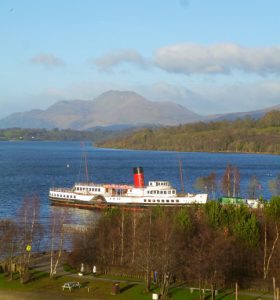
The Maid of the Loch at Balloch with Ben Lomond behind

January 1st 2017 – New Year’s Day – the sun shone and skies were blue. So what better way to start the year than by heading north to Loch Lomond.  We parked at Lomond Shores then set off to walk along a short stretch of the West Loch Lomond Cycle Path. This section of the cycle route is also part of the John Muir Way and takes you onto the Old Luss Road.

Nowadays it’s hard to imagine that the road alongside Loch Lomond wasn’t classified until the 1920s or that much of it followed the line of the 18th century Old Military Road. These military roads – built by General Wade and Major Caulfeild (sic) – linked the Central Lowlands with fortified army barracks in the Highlands; barracks which had been established to quell the Highland population after the first Jacobite Rebellion in 1715. One of the best known of these today is the old road between Glen Kinglas and  Glen Croe, the Rest and Be Thankful.

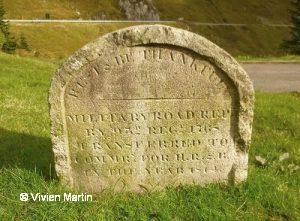
“REST & BE THANKFUL: MILITARY ROAD REPd BY 93rd REGt 1768 TRANSFERRED TO COMMRs FOR H, R & C IN THE YEAR 1814”

In the early 19th century the Loch Lomond route was surveyed and improved by the renowned Scottish civil engineer Thomas Telford. Telford, a poor shepherd’s son, was born in Dumfriesshire in 1757, yet became the most outstanding canal- and road-builder of his time.  His system of road-building involved several layers of stone, topped by cobbles, coupled with adequate drainage, all of which made for hard-wearing, long-lasting roads: labour-intensive, but not high-tech.

The decade after the First World War saw car ownership increase rapidly and the 1920 Road Act highlighted the poor state of Britain’s roads. Road classification was introduced and high unemployment levels after that terrible war meant there was a ready pool of labour available for a widespread programme of new road building. But, in many parts of Scotland, I doubt Thomas Telford would have seen a huge difference between his roads and those a century later in the 1930s! And it wasn’t until the 1980s that the modern, widened road we know today was built between Balloch Roundabout and Tarbet.

Fortunately for walkers and cyclists a number of stretches of the older road still exist and these follow the shore of the loch more closely that the new road does. So we undoubtedly get the best views! And we certainly saw plenty of cyclists making the most of the good weather.

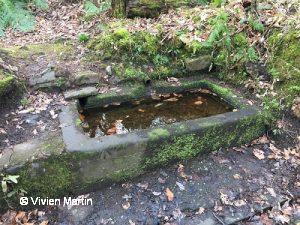
The stone water trough on the Old Luss Road

Here and there are indications of older times: an old stone horse trough, a gate to nowhere, an old lodge house and crumbling gates to former estate buildings. And on one side of the road stone walls and beech hedges have been left to their own devices and morphed into strange hybrid shapes along the roadside!

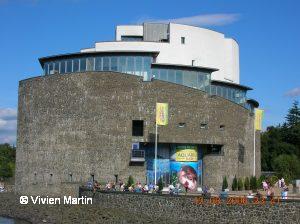
On our return to Lomond Shores we tucked into a hot and tasty lunch in the cafe high up in the Drumkinnon Tower, while enjoying the stunning views over the the loch, to the paddle steamer the Maid of the Loch and towards Ben Lomond.  The aquarium below was full of visitors, mostly families with children who were full of excitement at the array of aquatic creatures they had just seen: from the family of otters – Lily, Pickle and Cub – to tiny seahorses, sharks and the cartoon-like cow-nosed rays.

The mighty Drumkinnon Tower at Lomond Shores, which houses the aquarium and a cafe with stunning views over the loch

For us this was a gentle day out, but for the more adventurous – and fitter – there’s always the Tree Zone, an aerial adventure course. And if you want a really great way to discover the park area, then go for one of Scotland’s Wild’s active tours. There really are so many different ways to discover and enjoy this wonderful part of Scotland.

And that’s a good thought for a brand New Year!

Maid of the Loch

Sea Life Aquarium, Loch Lomond

Lomond Shores

Lomond and Trossachs National Park

Scotland’s Wild for active tours of the National Park area

Tree Zone Loch Lomond

The Christmas Robin – a tiny living Prayer

I have a good friend, for whom the sight of a robin is a reminder of her much-loved and much-missed mother. Seeing a robin flit by is always a welcome sight for her. A reassurance. A tiny living prayer.

It made me wonder why certain birds and animals have acquired a particular significance. Harbingers of good – or bad – luck.  It could be a black cat crossing your path. Rabbits and their feet. Magpies with ‘One for sorrow, two for joy…’ And there are many more. Today robins have a strong association with Christmas and even a cursory glance at a pile of Christmas cards will reveal many picturing bright little robins. What brought this about?

One story I read tells of the very first Christmas when a robin was bravely fanning the dying embers of the fire in the stable where the infant Jesus lay sleeping. If the fire went out the child would be chilled. The robin didn’t give up, but gathered twigs to keep the fire alight. A hot spark leapt from the fire and the little robin’s breast was burnt red. When Mary returned she blessed the robin for his care of her baby son, and for his bravery. From then on all robins carried a redbreast, a proud reminder of their generous act. And thus began their close association with Christmas.

Another legend tells of a robin trying to ease Jesus’ pain at the crucifixion by removing one of the vicious barbs from the crown of thorns. Some of Christ’s blood splashed onto the robin’s breast, again to become a permanent marker of the little bird’s bravery and compassion.

More mundane perhaps, is the story that Victorian postmen, clad in their bright red jackets, became known as ‘robin redbreasts’ and before long a robin appeared on an early Christmas card. Christmas cards were a new idea in the mid-19th century and rapidly became very popular. The robin has had pride of place there ever since!

One curious fact I discovered: look closely and you’ll see that a robin’s breast is orange, rather than red. It seems that the colour we know as orange today – named from the fruit – didn’t exist in the English language until the 16th century and wasn’t used as a distinct colour name until much later. ‘Robin Orangebreast’ doesn’t sound quite the same, though, and definitely lacks alliterative appeal!

But however their name, or their connection with Christmas, really came about, they are bright-eyed, intelligent, engaging little birds. Gardeners know that as soon as you turn the soil a robin will be there watching you closely, following your movements on the lookout for food in the disturbed earth. I find it a great pleasure to see these delightful creatures in my garden, or wherever I am outdoors. And the notion of their being a tiny living prayer is one I’m more than happy to go along with. Especially at Christmas.

The Camping Coach of Adventure!

“A CAMPING COACH. Another recent form of holiday-making by rail is in the camping coach. These coaches stand in some remote, rural siding and come under the care of the local station-master.” (From Railway Wonders of the World, April 1935)

Can you imagine how exciting it must have been for children to have their very own railway carriage to live in? In the summer of 1963 we had just that, and had one of the best family holidays ever! A converted railway carriage that sat on a siding beside the station at Plockton. Perfect accommodation set in a stunning location on the north-west coast of Scotland.

The carriage was fitted out with a kitchen, living and dining area and three ‘bedrooms’. The only thing lacking was a toilet, but we were free to use the station toilet, with ‘potties’ to hand for young children in the night!

In those days Plockton, a Highland village on the shores of Loch Carron, had yet to acquire fame as the fictional home of PC Hamish Macbeth (and who can forget Robert Carlyle in the role?). But it was definitely well-known as a wonderful place to spend the summer.  Close to sea, loch, hill and glen.

As children growing up with books like Swallows and Amazons, the Famous Five and Sheila Stuart’s Alison books, there couldn’t have been a more perfect a place for a holiday. We were ready to swim, row, fish, cycle, explore caves, find treasure, climb trees, scale cliffs, foil dastardly crooks: in short, we were ready for adventure! And while the Famous Five might have had their own island and lighthouse, we felt we were doing just as well spending the long summer holidays in a railway carriage!

Why camping coaches? The first coaches made their appearance in the 1930s at a time when cycling, hiking and camping were becoming increasingly popular among Britain’s urban population. Very many people still lived crammed into the grimy, heavily-industrialised cities, where pollution, in particular smog, was a problem.

We might think that smog was only a problem in late Victorian times; a useful cover for criminals in Arthur Conan Doyle’s Sherlock Holmes stories, or the infamous and creepy pea-soupers of old black and white films watched on wet Sunday afternoons. But in reality smog was deadly problem long after that. In fact, as late as 1952 the Great Smog in London is believed to have caused up to 12,000 deaths and ultimately prompted the 1956 Clean Air Act.

As holidays became more common, and for longer periods, people sought the fresh, clean air of the countryside. For families with children camping coaches held a greater appeal than spending your holiday under canvas. In the railway coach you had a proper roof over your head and more space, but were still away from home. They were also usually set beside beautiful remote rural and coastal areas of Britain. Cheaper too than a guest house. Private cars were not common, so being able to take the train right to your holiday doorstep was an additional bonus.

World War II saw the coaches taken out of service, but for two decades after the war they flourished again, better equipped and more luxurious than before.  Till along came Richard Beeching with his axe: lines were closed, stations closed and many of the most popular camping coach sites disappeared. Cheap flights and holidays in the sun also played their part in ending this unique type of holiday.

The camping coach at Plockton may be long gone, but today the station building itself is available for holidays. And in a few places the camping coach is making a come-back. So if you have fond memories from your childhood, or have children who revel in Thomas the Tank Engine, then one of today’s new camping coaches might just be the place for you!  It certainly was a brilliant ‘Camping Coach of Adventure’ for us !

Inchcailloch: “A part of the world and a world of its own”

“Nights and days came and passed, and summer and winter and the rain. And it was good to be a little Island. A part of the world and a world of its own, all surrounded by the bright blue sea.”
― Margaret Wise Brown, The Little Island

The Margaret at the landing stage on Inchcailloch with Conic Hill and the West Highland Way beyond

It’s little more than a ditty, but Margaret Brown’s poem sums up beautifully what it means to be an island: “A part of the world and a world of its own.” I suspect that also sums up the way many of us feel at times! An island offers that bit of distance, that apartness that we often need to slow down and deal with all that goes on in our busy, and all-too-often fraught, lives.

I’m fortunate to live on the West Coast of Scotland and have islands all around. This week my son and I drove to Balmaha on the east bank of Loch Lomond, where we had lunch in the delightful Oak Tree Inn. We then took the little mail boat from Macfarlane’s Boatyard over to Inchcailloch. The ferry, the 1947 30′ long Margaret, plies back and forth throughout the day taking visitors to and from the jetty at North Bay on Inchcailloch. It’s only a few minutes sail away, but as soon as you step ashore realise that you’re in a different world.

Welcome to Inchcailloch!

Up the steep and twisting stone steps and then through the woods we went. Oak trees abound here, providing a rich habitat for animals and plants. Alders too, those water-loving trees that thrive in damp conditions and help fight erosion. Rowans, or Mountain Ash, are there in plenty as well. With their rich red berries they were believed to have magical properties for combatting evil and were often planted beside cottage doors to ward off malign spirits.

The sun shone through the trees and dappled the path in front of us. Our first stop was the old burial ground, where ‘saints and sinners’ alike lie buried. The island’s original Gaelic name is Innis Caillich, which means the Isle of the Old Women, or Cowled Women (ie nuns). This ties in with the tradition that St Kentigerna, the daughter of an Irish King, settled on the island and then established a nunnery here. She is believed to have died in 733 AD.

With such sacred associations the island became home to a 12th century chapel dedicated to St Kentigerna’s memory, with a later parish church and burial ground used by people living in the small scattered communities around the shores of Loch Lomond. Islands were often favoured spots for graveyards as they were safe from scavenging wolves and other wild animals that might be on the lookout for fresh bones! So far, the earliest gravestone discovered dates back to the 13th century.

Digitalis or Foxgloves

Before there was a pier at the North Bay, boats beached on the shore below Ballach an Eoin, the Gaelic for Pass of the Birds. Almost everthing that arrived on the island, or was transported from it, came this way, and that included the coffins for burial in the graveyard. It’s not unusual to find Coffin Roads or Coffin Glens in Scotland, and this was one of them.

Over the centuries Inchcailloch was many things: a hunting ground for kings and queens, where deer could roam safely away from predators (other than human ones!): while for centuries there was farming on the island until the landowner ended agriculture in favour of the (for him) more profitable planting of oak trees, which became important as a rich source of timber and bark for tanning.

Today it’s a peaceful place, carefully managed by Loch Lomond & the Trossachs National Park, there for both people and nature to enjoy.  And this little “world of its own” is just waiting for you to come and visit!


Useful Links:

Loch Lomond & Trossachs National Park

Balmaha Boatyard

Oak Tree Inn

Scotland’s Wild, Tours of Loch Lomond and the Trossachs

 Camping on Inchcailloch

“There’s been a murder…!” Bute Noir Investigated

Mass murders approach the unsuspecting citizens of Bute!Last weekend the Isle of Bute basked in sunshine, its worthy citizens little realising that a ferry-load of mass murderers, psychopaths and serial killers (both male and female) were about to set foot on their beloved island: unaware that a gang of killers was about to hit the streets of Rothesay, the capital of this peaceful west coast island.

From California to Govan they came, each with their own unique and perfected methods of murder. Each with their own preferences for death and carnage. But thankfully on this occasion no blood would be spilt, for these desperadoes kill not with daggers or guns, but with the pen!

Californian Alexandra Sokoloff and Glaswegian Chris Brookmyre get to grips with hard questions from the audience in Rothesay Library

Thus it was that journalist-turned-crime-writier Craig Robertson and his band of Tartan Noir friends arrived on the island for the first ever Bute Noir crime writing festival and what a success it was!

Organised jointly by Craig, along with Karen Latto of Print Point (Rothesay’s wonderful bookshop) and the library’s Patricia MacArthur, the talks were hosted across three venues: by Karen at Print Point, by Kevin Baker at Rothesay Library and by Anne Spiers at Bute Museum.

Library staff kept us all fed and watered!

The topics ranged from the serious to the comic – from the grim reality that lies behind much of crime writing, to “squirrels on steroids, heads in fridges and the perfect writing paper…!” to quote the island’s newspaper, The Buteman.

The visiting authors looked at what lies behind the personalities of serial killers; discussed the way different women approach crime writing (‘Deadlier than the Male?’);  debated the extent to which locations add to the realism of a novel; talked about the writing of the ‘cosy’ crime novels that many readers also appreciate; then brought the festival to a hilarious finale with a ‘Question of Court’, when Chris Brookmyre, Luca Veste and Michael J. Malone pitted their wits and literary knowledge against the sharp minds of Caro Ramsay, Douglas Skelton and G.J.Brown.

Prepare to be afraid, very afraid!

Prepare to be afraid, very afraid!

The island played its part too as the Bute Noir programmes and posters all featured the atmospheric and eerie photograph of the road to the Dhu Loch, taken by talented Bute photographer John Williams. The evocative image of a dark and winding road through trees, leading to an unknown and mysterious destination, was just the thing to get your imagination going and send a shiver or two down your spine!

This inaugural Bute Noir was a good mix of gentler crime, alongside police procedurals and the darker Tartan Noir: with a slice of the mysterious and the supernatural thrown in as well. The turnout for all the events showed just how much interest there is in all aspects of the process of writing – from the original spark of an idea to the final published book.

Chris Brookmyre, Luca Veste, Michael J. Malone, quizmaster Craig Robertson, Caro Ramsay and Douglas Skelton get reay for a trial of wits in a 'Question of Court'

Chris Brookmyre, Luca Veste, Michael J. Malone, quizmaster Craig Robertson, Caro Ramsay and Douglas Skelton get ready for a trial of wits in a ‘Question of Court’

All in all, a great success and if you missed meeting these dealers in death this time round: fear not – They’ll be back!!

**********************************************

Find out more at:

How unique is Scottish Crime Fiction by Allan Martin

Bute Museum