“How are the mighty fallen… ” Helme Castle in Estonia

“How are the mighty fallen and the weapons of war perished.” 2 Sam 1:19

When the Teutonic Knights began their Northern Crusade and swept through the Baltic States in the 12th century, they would have found it hard to imagine that their once mighty fortresses would end up nothing more than heaps of rubble.  But we know that empires rise and then fall. Ruling dynasties weaken and fade away. Powerful elites come and go.  And if there’s one thing that history teaches us, it’s that change is the only constant throughout.

A couple of weeks ago we visited the remains of one of these Teutonic fortresses, Helme Castle in Southern Estonia. Built in the 13th century it was a massive oval-shaped stone fortress surrounded by two moats. From here the knights ruled the surrounding lands (now Estonia and Latvia) with an iron fist.

The castle was an unmistakable and seemingly impregnable symbol of power and control, but it all came crashing down during the Russo-Swedish War of 1656-1658. With strategically placed barrels of gunpowder, the Swedes blew it up to keep it out of Russian hands. Only small sections of the walls remain today, and we were surprised to see that they are propped up with even more rickety-looking wooden scaffolding!

The Teutonic Knights used the excuse of the ‘Christianisation’ of the pagan peoples of Old Prussia and the Baltics to raid, slaughter and then rule the lands they brutally conquered. In time they turned to attacking neighbouring Christian states as their desire for power and wealth grew. Greed, not faith, lay at the heart of their actions.

Power and control can be wielded in many and varied ways. Throughout history people have been ruled by the power of the sword. Fortunately for most of us in the West today that’s no longer the case and we tend to believe ourselves to be free of these sort of tyrannies.  But is that really the case?

It’s no longer possible for any of us to deny that the equally brutal power of institutional corruption controls much of the world we live in now, and in many ways decides our fate and permeates our daily lives as much as the Knights of the Sword did in medieval times.  And again it’s greed that lies at the heart of it all.

Roberto Saviano, the brave Italian journalist and writer, has spoken out fearlessly against organized crime – crime that comes in many guises. Institutional corruption is perhaps the most malignant and all-pervading crime we face today. Recently Saviano said: “It’s not the bureaucracy, it’s not the police, it’s not the politics but what is corrupt is the financial capital. 90 per cent of the owners of capital in London have their headquarters offshore. Jersey and the Caymans are the access gates to criminal capital in Europe and the UK is the country that allows it.”

So while we may not be faced with sword-wielding, armour-clad brutes, we are certainly living in a world where the evils of greed and corruption are destroying not only our chances for a fairer society, but also the future of our children.

Set in beautiful woodland

Unfortunately the power of institutional corruption is so much harder to eradicate than that of medieval knights.  But it’s still up to us to do all we can to signal clearly what is right and what is wrong.

It’s easy to feel helpless in the face of such massive immorality. That’s why it’s so important to remember that nothing in life is fixed or final and that change is always possible. Though never an easy or comfortable task, our predecessors have fought for change every step of the way to give us the freedoms we have today.  And it’s our turn to follow in their footsteps.

Now, where’s that gunpowder?!

“If you go down to the woods today…” The Lochan Spling Trail

“If you go down to the woods today…”

“Keep close to Nature’s heart … and break clear away, once in a while, and climb a mountain or spend a week in the woods. Wash your spirit clean.” John Muir (1838 -1914)

Wise words from a wise man, and as true today as back then. If fact, probably truer today than ever before. A survey undertaken by Scottish Natural Heritage (SNH) in 2014 reported that 90% of people found that visiting the outdoors helped them to relax and reduced stress, while 80% felt that being outdoors not only improved their physical health, but also left them feeling both energised and revitalised.  No mean achievement! We are very fortunate that Scotland is rich in forests and forest walks: so just what awaits us if we go down to the woods today?

The aptly named Old-Man’s-Beard

For a start fresh, clean, unpolluted air. Take a look around and marvel at the abundance of lichen draped over the branches of trees: in particular the aptly named Old-Man’s-Beard!  Then there are all the wonderful smells and sounds of a forest.  Birds and bird song all around, the glimpse of animals through the trees, while strange mushrooms and toadstools thrive on fallen trees. A forest creates its own world, its own rich eco-system from the top of the tallest trees to the smallest creepy-crawlies and strangest looking fungi! A gentle poke in the undergrowth will quickly reveal all sorts of life – much of it scurrying hastily away!

Weird and wonderful growths

At the weekend we set out from Aberfoyle, ‘the gateway to the Trossachs’, along the Forestry Commission’s Lochan Spling Trail.  Spling is a strange name and may come from the Gaelic word splàng, which means to sparkle. In Sunday’s sunshine, with its welcome warmth, that certainly seemed an appropriate name! As we walked through the forest and across the Duchray Water we met other walkers and cyclists, as well as groups of young people learning outdoor skills through the Duke of Edinburgh Award scheme.

A grumpy looking fungus!

Reaching the lochan, we suddenly found ourselves face-to-face with some very unexpected, and very out-sized, creatures! The Lochan Spling Pike, Dragonfly and Osprey were all created by artist Rob Mulholland in 2008 and form part of the Loch Ard Family Sculpture Trail, which runs not only around this delightful lochan but also along the shores of Loch Ard, Little Loch Ard and Lochan a’ Ghleannin. The three we saw are quite remarkable objects and reflect the creatures that live in the lochan and surrounding forest.

The gigantic Lochan Spling Pike

There is so much to see, do and enjoy in a forest, and at the same time it is so good for us. Like John Muir, Søren Kierkegaard, the 19th century Danish philosopher, was also keenly aware of the benefits of taking time to be outdoors, and in particular walking, until our problems take on a more manageable perspective. In 1847 he wrote: “Above all, do not lose your desire to walk: every day I walk myself into a state of well-being and walk away from every illness. I have walked myself into my best thoughts, and I know of no thought so burdensome that one cannot walk away from it.” Coming from the man widely regarded as the world’s first existentialist philosopher, that’s good advice indeed!

The Lochan Spling Dragonfly

All of which just goes to show that if you go down to the woods today you really will find plenty of surprises, plenty to enjoy and come back feeling refreshed and revitalised! And that’s got to be a good thing!

Links:

Lochan Spling Trail: Forestry Commission Scotland

John Muir, Scottish environmentalist and naturalist, and ‘Father of the US National Parks’

Loch Lomond and the Trossachs National Park

Brig O’Turk Tearoom – a unique restaurant in a village with three names

The world-famous Brig O’Turk Tearoom in the heart of the Trossachs

*Sadly the tea room is now closed

What’s in a name?  Plenty, when it comes to the village of Brig O’Turk in the heart of the Trossachs! This small rural settlement has two older Gaelic names; Ceann Drochaid (end of the bridge) and Aird cheannchnocain (the height at the end of the hillock), while the present-day name of Brig O’Turk, despite how it may sound, has no connection with a distinguished Turkish gentleman!  Instead it combines the Scots word brig (bridge), with the Gaelic word torc (wild boar) to give the dramatic sounding Bridge of the Wild Boar.

Just some of the appetizing dishes on offer at the tearoom!

But however many names the village has, it boasts one very unique eating establishment! And that is the delightful Brig O’Turk Tearoom, well-known both for its wonderful food and as a key location in the 1959 remake of John Buchan’s classic The 39 Steps. Starring Kenneth More, much of this version was filmed in and around the Trossachs with the fictional tearoom bearing the name The Gallows Cafe. It’s portrayed as a popular stopping point for cyclists (as it was in reality), and it’s from here that we see our hero make his escape by peddling off, hidden amongst a group of other cyclists, dressed in rather improbable cycling gear!

The 29 Steps, 1959, with Kenneth More and Taina Elg

There are wonderful cycle and walking routes all around this area, up through Glen Finglas and along the new Great Trossachs Path, which was opened in 2015. The Path links into the West Highland Way and the Rob Roy Way, and runs from Kilmahog, just outside Callander, to Inversnaid on the eastern shore of Loch Lomond, passing en route the lochs Venachar, Achray, Katrine and Arklet.

The Great Trossachs Forest is a vast, long-term woodland regeneration project, devised jointly by the RSPB Scotland, Forestry Commission Scotland and the Woodland Trust Scotland, and offers a growing number of routes, with something for every age and ability, and is packed with information about the history of this ancient landscape.

Built in 1923, the tearoom retains much of its original atmosphere, and has food to climb a mountain for!

And sitting right at the heart of all this wonderful countryside is the Brig O’Turk Tearoom, run since 2011 by Csaba & Veronica Brünner. The couple have brought new life – and many new tastes – to this much-loved tearoom.  So take to the hills, follow in the footsteps of Sir Walter Scott, William Wordsworth, John Ruskin, Effie Gray, John Everett Millais and his Pre-Raphaelite brotherhood, Jules Verne and very many others and come and explore the Trossachs. Then reward yourself with a visit to the Brig O’Turk Tearoom!

Links:

Glen Finglas and the Great Trossachs Forest

The 39 Steps Trossachs Locations

 Loch Lomond and the Trossachs National Park

Estonia: Flying the flag – or how traditions can save a nation (Part 3)

St Andrew’s Cross – the Saltire – seen in the sky!

Sometimes, on a clear sunny day when the sky is blue, the vapour trails from jets flying high overhead can leave a beautiful image of the Saltire, Scotland’s national flag.  The Saltire is believed to be one of the oldest national flags in the world and although no-one knows for certain how it came to be chosen, tradition has it that in AD 832 an army of Picts under King Óengus (Angus), with support from Dalriadan Scots, found themselves surrounded and outnumbered by Angles.

The Flag Heritage Centre at Athelstaneford

Things looked bad and Angus prayed for divine help: to his amazement the clouds formed a white Saltire against the blue sky and the Picts and Scots won the battle.  St Andrew became the patron saint of Scotland and the Saltire, St Andrew’s Cross, became our flag.

In the East Lothian village of Athelstaneford – where that momentous battle is believed to have taken place – the Scottish Flag Trust run the Flag Heritage Centre where the story of Scotland’s flag is told.

St Mary’s Church in Otepää

When we were back in Estonia in May of this year, we visited Otepää, a ski resort in southern Estonia, the country’s ‘winter capital’. There we discovered that, like Athelstaneford in Scotland, Otepää had played an important part in the history of the national flag of Estonia. In St Mary’s Lutheran Church we heard how the blue, black and white – the sinimustvalge – of Estonia’s flag came from the three colours in the caps worn by Tartu University students in the 19th century: and that these three colours were also used in the Estonian Student Union flag.

It was this flag that was consecrated in St Mary’s Church in 1884 to become the national flag of the whole country.  In 1918, when the Estonian Republic was established, these three colours  became the new republic’s official national colours.  Then in 1991, when Estonia once again regained its independence,  it became the official flag of the the Republic of Estonia.

Traditional Estonian student caps at Tartu University

Otepää is home to the Estonian Flag Room which was established in 1996 to commemorate their flag – a flag that is as important to Estonians as the Saltire is to Scots. In fact, it was a delight to see so many Estonian flags being carried and waved with pride at Laulupidu, the Song Festival the previous year: not waved in anger, or superiority – but as a natural part of their lives : this is my land and I love it!

Today, November 30th, is St Andrew’s Day and is celebrated by Scots the world over. Celebrated as a mark of respect for our country and its long history. Celebrated as a sign of our shared heritage and identity. Celebrated to mark all that is good about Scotland. Almost every other country in the world celebrates their homeland in a similar way.

Bas-relief at St Mary’s Church celebrating the consecration of the flag in 1884

Symbols are important. Identity is important. Knowing where you belong, and why, is important. Sadly some people deliberately attempt to equate national pride with imperialism or xenophobia. A foolish mistake. For there is no doubt at all that it’s good to know who we are and what we believe in. It’s good to know about our past and to understand – and value – the struggles of all the ordinary people that have brought us to the point we are at now: though it can also be daunting to know that we have to play our part in these difficult times if we are to ensure that our country continues to grow and develop in a way that is good for all its citizens and not just the few.

Flags are wonderful symbols and I will be celebrating St Andrew’s Day this evening. But I’ll be celebrating Scotland every other day of the year as well!

The Flag Room in Otepää

The Flag Heritage Centre

The Estonian Flag Room in Otepää

 Laulupidu

Estonia: The Magic of Laulupidu – or how traditions can save a nation (Part 2)

Choirs gather in Tallinn from all over Estonia and beyond

Music and song play a great part in life in Scotland. We have a long and rich tradition of songs that reflect all aspects of life in this country. We grow up hearing the profound message in Robert Burns’ A Man’s a Man for A’ That, sung so movingly by Sheena Wellington at the opening of the Scottish Parliament in 1999.   Or For Auld Lang Syne, arguably the most-played and best-known song in the world. We have songs that talk of the common humanity we all share, despite the fact that it’s still very much an ill-divided world.

The procession from Tallinn to the Song Festival Grounds lasted for hours!

There are also songs of anger and frustration that the greed and corruption of the few can make life a misery for so many. Songs that are full of history and the tragedy that is man’s inhumanity to man. But again there are songs like Dougie MacLean’s heartfelt Caledonia, that celebrate the beauty of our landscape and our love for our country. Songs full of longing for justice and equality, for love, for basic human kindness. Songs that reflect the past and future hopes our nation.  Songs that add to what it means to be Scottish.

Beautiful traditional costumes

I was both intrigued and delighted when I discovered that music and song play a huge part in the life of the Baltic nation of Estonia, especially the song festivals that kept their culture and identity alive during centuries of foreign occupation. A few years ago a friend gave me a copy of a documentary called The Singing Revolution, made by a Canadian/Estonian couple, James and Maureen Tusty.  It’s perhaps one of the most moving films I have ever seen and tells of the brave and peaceful struggle by the people of Estonia to be free of the Soviet Union.  And, amazingly, how that long-standing tradition of music and song helped make the revolution possible.

The flame lit, Laulupidu could begin

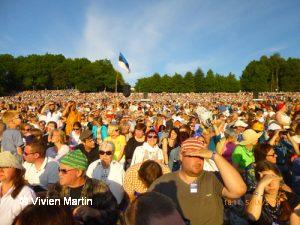
This national Song Festival – Laulupidu – takes place once every five years, so when we returned to Estonia in 2014 we made sure we had tickets – and it’s an event I’ll never forget. Seeing people of all ages, from all over Estonia and beyond, descend on Tallinn in a breathtaking array of costumes was unforgettable. Then there was the patience of more than 25,000 singers as they waited in the blistering July heat to take their places in the opening procession from the heart of Tallinn to the song festival grounds.  Throughout the whole weekend the atmosphere was one of celebration, thankfulness, fun and friendship: hundreds of thousands of people and barely a policeman or security guard in sight – nor any mess either!

100,000 people undeterred by the blistering July heat!

The singing was a mix of old and new songs – songs from the early days of the song festivals as well as by musicians and composers who had lived through the Singing Revolution themselves.  It’s almost impossible to decide on a favourite song, but two that I particularly enjoyed were Rein Rannap’s Ilus Maa (Beautiful Land) and René Eespere’s Ärkamise Aeg (Time of Awakening): both with a hymn-like quality and performed with real conviction and sincerity by almost 30,000 singers on the stage – feelings echoed by 80,000 more in the audience.

More than 25,000 singers take to the stage!

The pride in country and history that the people of Estonia wear so naturally is something we can all learn from: a nation that has no desire to force others to be like them, but instead celebrates the  joy of finally being able to be themselves.  Something that is so important to all people.

History never stands still.  Empires come and go. We bring up our children to become free and independent people, not eternally dependent on us.  Over and over again history shows us that peoples and nations – on every continent in the world – reach a point when it’s time for them to be free to make their own decisions about how their country is governed and how it treats its citizens.

A child steps out confidently, secure in her future thanks to her past

For me, what Estonia achieved – and how it achieved it – is something to be remembered and cherished: and is an example to us all as to how, no matter how long it may take,  lasting change can be made.

Links: The Singing Revolution 

The Singing Revolution: trailer

Ilus Maa (song)

Ärkamise Aeg (song)

The Corries sing A Man’s a Man for A’That

Estonia: The mysteries of Kihnu Troi – or how traditions can save a nation (Part 1)

Underway! Knitting mittens from a traditional Kihnu island pattern

Kihnu Troi – it sounds like a character from a Star Wars film, but is in fact a very distinctive style of Estonian men’s sweater with a unique two-colour braided cast-on!  Kihnu (the ‘h’ is sounded) is an island lying in the Gulf of Riga, Troi their famous traditional knitwear originally worn by the men of this fishing community.

Like exquisite Shetland lace, or Fair Isle sweaters, each region of Estonia has its own unique, intricate and colourful designs. Socks, mittens, jumpers; all as bright and hard-wearing as anything we have in Scotland. Kihnu patterns use black and white wool, with contrasting red bands around hems, cuffs and necks: bands that were believed to grant protection to the wearer.   Knitted from very fine wool, all these garments can last for more than a lifetime.

The powerful medieval Bishop’s Castle on the island of Saaremaa

Estonia’s geographical position has had a profound influence on its turbulent history. Being flat and fertile this small country has found itself repeatedly in the path of invading empires: from ferocious Viking raiders to German, Danish, Swedish, Russian, Nazi and Soviet occupations. It’s a country that has certainly experienced more than its fair share of history!

I’ve visited Estonia a number of times now.  Like Scotland, it’s a country with many islands around its coast, and while geographically different from Scotland (unlike Scotland Estonia is very flat), the inhabitants of these Baltic islands have experienced harsh and difficult conditions that have influenced their lives just as much as times of great hardship have shaped the character of Scotland’s island communities.

But trials and tribulation can breed determination and resilience. Difficulties are overcome and life goes on.  In 1991 Estonia regained its independence from the Soviet Union and the road to recovery began.  Huge changes had to be faced politically and economically, but face them they did.

Suitsuräime – smoked herring Estonian style on the island of Muhu

As in Scotland, the days of the great fleets of trawlers are gone: instead the focus is now on good, sustainable local produce, with smoked Baltic herring, sprats and eels being the most popular.  We tried some of these specialties: suitsuräime (smoked Baltic herring),  suitsuangerjas (smoked eel) and suitsukilu (smoked sprats).  Not quite Arbroath Smokies, but tasty nonetheless!  And if you’re on foot on the island of Saaremaa, the Pithla Õlu, a beer so close to home-made that it only comes in barrels, and Saaremaa vodka (especially the rhubarb one) are worth a shot (or two)!

Beautifully restored wooden houses from the Tsarist era

The knitters among you will know just how complicated Kihnu Troi cast-on is, and I have to admit that I didn’t quite manage it this time.  But the end result – my first pair of Estonian mittens – give me real pleasure and they will stand me in good stead in the coming winter months.  It wasn’t easy to find wool as fine as that recommended in American knitter Nancy Bush’s pattern book “Folk Knitting in Estonia” but I was fortunate to find a Shetland wool equivalent in The Yarn Cake, a great little knitting shop in Glasgow.

Estonian mittens I knitted based on Nancy Bush’s Kihnu pattern

I’ve written about some of the similarities between Scottish and Estonian islands in Scottish Islands Explorer: Two countries very different in some ways, but also with many shared characteristics when it comes to their islands.  Long-standing and deep-rooted traditions help hold these communities together through thick and thin.  And that adds strength and stability to the nations they are part of. Estonia is a beautiful country, steeped in history and well worth a visit.

And perhaps the madder-red bands of my Kihnu mittens will indeed give me added protection from danger!  I hope so.

Links: The Yarn CakeKihnu Troi Braided Cast-on  and  Nancy Bush: Folk Knitting in Estonia

Looking for Brigadoon? It’s in Wester Ross under Loch Glascarnoch!

A drowned bridge on a drowned road – across the bed of Loch Glascarnoch

It’s supposed to appear for one day only, once every hundred years, Brigadoon, the fabled Highland village.  Now, intriguingly, after almost 60 years under water, the old road through Glen Glascarnoch to Ullapool has reappeared in a similar fashion!

Up until the 1950s the main road from Inverness to Ullapool ran through the middle of the glen.  Though the term ‘main road’ may conjure up false images for many today: back then, as in so much of the Highlands and Islands, it was still only a single track road with passing places.

The old lost road to Ullapool

Throughout the 1940s, 50s and 60s, an unparalleled hydro-electric scheme was created throughout the Highlands, bringing ‘Power to the Glens’ for the first time ever. Glascarnoch Glen was dammed and an artificial loch, Loch Glascarnoch, created to hold water from Loch Vaich and Loch Droma, before feeding into the hydro system at  Mossford Power Station, five miles away.  When the dam was built the road was lost forever – or so it seemed.

Looking north to the drowned bridge

Earlier this year SSE (Scottish and Southern Energy) decided to lower the water level in Loch Glascarnoch as a preparation for potential heavy autumn and winter rains, and suddenly there it was  – the ‘lost’ road – and with hardly a pothole to be seen!

It was a dramatic sight and when we arrived a number of people were already taking the opportunity to walk this ghost road while it’s still possible.  We walked for a mile or so, made it across the bridge (thanks to wellies) and perhaps half a mile or so further, but at that point the mud thickened and the road disappeared back into the dark water, and it was time to return to the car.

Old tree roots visible for the first time in 60 years

It was fascinating to see old tree roots, but also interesting to see just how quickly much of the area had become green: tiny plants and grasses taking this rare opportunity to burst out between rocks and mud.  But, just like Brigadoon, the rains will come and this old ghost road and its bridges will disappear once again too. And, who knows, might well become just another strange tale of the mysterious and misty Highlands!!

Aoineadh Mor – Morvern’s past re-examined

“An latha dh’fhàg sinn an t-Aoineadh-mòr shaoil mi gun sgàineadh mo chridhe” (The day we left Aoineadh Mòr I thought my heart would break) – Mary Cameron

Aoineadh Mor, Morvern

It’s strange the things you remember from the past. At my first Scottish History tutorial at Edinburgh University many years ago, our tutor told us that much of history is myth, and that he wanted to start our course with some ‘myth-busting’.  Firstly, he said, the Vikings didn’t go around in horned helmets – certainly not into battle – and secondly, the Highland Clearances were purely economic, had to happen and were not that bad really.

That the Vikings wore horned helmets for ceremonial purposes only made sense – but forcing people from their homes and claiming “it wasn’t that bad really” was another matter altogether. And not one we could accept. While it’s true that economic migration from the Highlands was already taking place – and taking place across all of Europe – the brutal evictions faced by so many native Highlanders tell a very different story indeed.

The still waters of Loch Arienas, close to Aoineadh Mor

Fortunately attitudes to the study of history have changed. The previous approach of kings, queens and dates of battles – the history many of us grew up with – has all but gone.  Sources and events have been re-assessed and a new, refreshing, and more honest emphasis placed on the lives of all.  And it makes history so much more interesting!

No-one can deny that the Highland Clearances are a particularly grim part of our nation’s history.  As large estates passed from hand to hand the new owners – from both Scotland and England – gave scarcely a thought to the people who lived on and worked the land: these people were invisible or regarded as being in the way, worthless.

Ruined house by the Allt an Aoineadh Mhoir burn

One clear and unequivocal example of the inhumanity of that period can be seen in the deserted township in Aoineadh Mòr in Morvern.  In 1824 the land was purchased by a wealthy Edinburgh woman, who promptly had the whole village evicted to make way for sheep.  Home to more than fifteen families, it had 22 houses and outbuildings, run-rigs for growing crops, grazing for cattle, kail-yards, corn-drying kilns and winnowing barns. A young woman, Mary Cameron, with her baby and two other small children, was among those forced from their homes, her husband James carrying his aged mother up the steep path from the glen.  As they looked back, the destruction of their homes was already taking place.

With nowhere else to go they had to make their way to Glasgow and hope for work along with thousands of other dispossessed people.  It was a cruel time of low wages, appalling housing and disease. With help from their minister, James did eventually find work, but both he and their eldest son Donald fell prey to the ‘infectious fever’ so prevalent in the overcrowded and insanitary city, and young Donald died. Mary later told her story to Rev Norman MacLeod, one of the MacLeods of Fiunary in Morvern, thus giving us a first-hand account of the tragic fate of this community.

Lichen – a sign of pure, clean air

Today the Forestry Commission are responsible for Aoineadh Mòr and its beautiful setting close to Loch Arienas. Lichen abounds, an indication of the pure clean air in the glen.  There is a car park and well-marked paths to the former township. The signage includes illustrations of how the settlement would have looked when full of life. It also gives explanations, and helpful pronunciations, of the Gaelic words associated with Aoineadh Mòr.  But be warned! Cleared forestry areas are seldom pleasant places – often more closely resembling WW1 battlefields than anything else! – and even reaching the picnic bench on the other side of the burn was a challenge!

Do we learn from history, from the mistakes and cruelties of the past? I hope so. Change is in the air with the new Land Reform bill proposed by the Scottish Government, and backed by the great majority of people in Scotland.  It’s also worth noting that there are individual landowners already taking innovative steps towards redressing housing problems in the Highlands e.g. the new settlement at Achabeag on the Ardtornish Estate. Wise and fair use of our land is to be welcomed by all.

Aoineadh Mòr – Forestry Commission Scotland

Land Reform Bill

Achabeag

Ardtornish Estate

Glen Finglas and the Great Trossachs Forest

A cyclist pauses to take in the view on the Great Trossachs Path

From medieval hunting parties to whisky smugglers, cattle rustlers and those incredible dam-building pioneers of renewable energy, the Hydro Boys, Glen Finglas has seen its fair share of excitement and change.  And that’s continuing today through the work of the Woodland Trust Scotland and the ongoing development of the Great Trossachs Forest.

A new information centre, the Glen Finglas Visitor Gateway, has been built at the Lendrick Hill car park and is the starting point for a whole range of walks; anything from half a mile to 15 miles. There’s also an option to follow the Great Trossachs Path itself, which runs for 30 miles from Callander all the way to Inversnaid on Loch Lomond.

Woodland Trust Scotland visitor centre at Lendrick Hill car park

What is it makes this area so interesting? In the early 19th century that founding father of Scottish tourism, Sir Walter Scott, immortalised both the Trossachs and Glen Finglas in his epic poem ‘Lady of the Lake’ and the ballad ‘Glenfinlas’. From that point on visitors flocked to the area, drawn by the rugged natural beauty of the hills, lochs and glens.  But also by the romantic tales and legends associated with the wild landscape.

Glen Finglas walks map

This notion of the romance of the wild saw many writers, artists and poets among the visitors, including the renowned naturalist, philosopher and social critic John Ruskin, one of the most influential men of his day, and a frequent visitor to the Trossachs. I was pleased to discover that it’s once again possible to go and stand by the rushing waters of the burn at the spot where Millais painted his famous portrait of Ruskin in1853. The Great Trossachs Forest project is not a ‘quick fix’, but an inspired and inspiring long-term plan to regenerate natural woodland and habitats. We took the Lendrick Hill and Dam walk, which, at its most northerly point, looks down on the gentle curve of the dam built in the 1960s as part of the massive Scotland-wide hydro-electric scheme.

The walk ends at the delightful Brig O’Turk Tea Room*, well-known both for its wonderful food but also as a key location in the 1959 remake of John Buchan’s classic The 39 Steps. Starring the debonair Kenneth More, much of this version was filmed in and around the Trossachs.  In one scene our hero makes his escape by peddling off, hidden amongst a group of other cyclists, whilst clad in a rather improbable fashion! The cyclists we saw that day were anything but improbable and it was great to see so many people getting real enjoyment from a trip to Glen Finglas.

The world-famous Brig O’Turk Tea Room!

*Sadly, the tea room is now closed

Take to the hills – the Rahoy Hills in Morvern!

The entrance to the Scottish Wildlife Trust and Ardtornish Estate reserve in the Rahoy Hills in Morvern

The ferry ride from Corran to Ardgour lasts only a matter of minutes. But those few minutes take you to the rugged and little-known Morvern Peninsula in south-west Lochaber on the dramatic west coast of Scotland. The name Morvern comes from the Gaelic A’Mhorbhairne, meaning the Sea-Gap. Head due west and you’ll reach Ardnamurchan, regarded as the most westerly point of the British mainland. Head south from Ardgour and you come to Morvern.

On a first visit to somewhere new it’s not alway seasy to know where to begin. Checking the map we thought the Scottish Wildlife Trust reserve in the Rahoy Hills might be worth a visit. And we weren’t wrong. Leaving the car at the small and rough Black Water car park on the Ardtornish Estate, we set out for Loch Arienas. This unusual sounding name derives from the Gaelic for Angus’ Shieling, or summer pasture. The natural beauty of the loch and the surrounding area were immediately clear to see.

Loch Arienas

Rich in plant- and wildlife, the track through the woods wends its way up and down and roundabout, sometimes boggy, sometimes narrow and twisty, but all the while giving splendid views onto the loch and its unusual sandy beaches. It’s also thanks to Morvern’s geology that the soil here is home to so many rare plants.

This reserve is particularly important as it contains rare surviving remnants of the historic native Atlantic oakwoods, once found along much of the Atlantic seaboard all the way from Norway to Portugal. Established in 1975 the Rahoy Hills Reserve is not only an SSSI (Site of Special Scientific Interest), but parts of it, as here at Loch Arienas, have been given extra protection as Special Areas of Conservation. And with good reason.

The bridge over the Arienas Burn

By allowing the trees to self-seed, a genuinely natural regeneration of the woodland is taking place and with that comes the accompanying natural growth of habitats for many other flora and fauna. A variety of native Scottish trees, such as hazel, ash, rowan and birch, intermingle with the oak, and under and around them an array of mosses, pure-air-loving lichen, ferns and the primitive – and often rather damp, slimy and strange looking! – liverworts are much in evidence. Add to this primroses, violets, bluebells and other small and delicate spring flora with their lovely yellow, blue, pink and lilac colours, and the setting is perfect.

Some of the ruins of Arienas village

But there is more here. Beautiful as the scenery may be and rich the flora and fauna, the glen has another story to tell. Like so many parts of Scotland the land seems empty now – empty of people that is. Yet like so many places in Scotland this glen was once home to many families. Continuing along the track we came to Arienas Point and the remains of the deserted township of Arienas.

This former settlement of seven houses, barns and a corn-drying kiln was built around 1755, but its inhabitants were ‘cleared’ in the 19th century to make way for sheep. These sad reminders of past lives aren’t the only indications of previous human habitation in this lovely glen. Archaeologically rich Bronze and Iron Age sites also lie nearby. Evidence that this has long been a place where people could, and did, live and call home.

Cairn memorial to the naturalist Brian Brookes

We also came across a cairn-memorial to the naturalist Brian Brookes, best-known now for the British Naturalists’ Association Guide to Mountain and Moorland. Perhaps it was a special place to him. It was without doubt a special place to many in the past and is here for us all today thanks to the Scottish Wildlife Trust and the Ardtornish Estate.