Loch Ardinning: nature on the doorstep

Loch Ardinning, a Scottish Wildlife Trust reserve

A day off and the sun is shining – so what better way to spend the time than to head out into the countryside! Living just north of Glasgow there is a wealth of beautiful countryside to chose from and one of my favourites is the Scottish Wildlife Trust’s reserve at Loch Ardinning.

Approaching Loch Ardinning from the south, you get stunning views of the Campsie Fells and Dumgoyne, a volcanic plug which is a well-known and very distinct local landmark. Today the Fells were snow-covered and with clear blue skies and bright sunshine looked even more splendid than usual.

The Campsie Fells and Dumgoyne from Loch Ardinning

The reserve covers 142  hectares of moorland, wetland and woodland as well as the loch itself. It may be a nature trail today, but some of the landscape has been shaped by man.  Within the boundaries of the reserve there is an old quarry which provided sandstone in the early 19th century for the foundations of the nearby main road (A81). While the dam at the start of the walk was originally built both to enlarge the loch and to provide water for the mills in the nearby Blane valley.  The loch itself is shallow and often freezes and in the past was a popular spot for curling – on the trail you can see the remains of the base of the former curling hut.

Heading up towards the cairn

It’s close to the city but nonetheless a varied and rugged landscape, and you get a great sense of being well away from the noise and bustle of the town. The trail guide and marker posts along the way provide interesting facts about what has shaped the land and what there is to see.

In fact, there is even a battle site on the reserve!  As the guide says : “Part of the rock formation used to be called Cat Craig, derived from the ancient British and Gaelic words meaning ‘battle rock’.  The earliest known historical reference to the area concerns the Battle of Ardunnion about AD570 when Gwallawg and his brother kings of Cumbria fought and defeated Hussa the son of the king of Bernicia. A fierce battle was fought between the rocks here and the Blane Water.”  So it’s not always been as peaceful around here as you might imagine!

The cairn, almost mid-way on the walk

Over the past fifty years The Scottish Wildlife Trust has established and managed 120 wildlife reserves the length and breadth of the country. Their vision and hard work has helped create, save and regenerate a wealth of sites.  And as in so many wonderful places in Scotland a fantastic job is done by the volunteers who maintain paths, ensure natural tree-regeneration, clear old blocked field drains, cut back invasive plants and carry out the hundred and one other tasks that go to make the reserve a pleasure for all to use. I have a huge admiration for the work they do keeping this beautiful country of ours beautiful and making it something that can be shared by us all.  There’s no doubt that in Scotland we are very fortunate indeed to have so much natural beauty right on our very doorstep – and it’s just waiting for you to get out and enjoy it!

Looking across the loch with the Campsies behind

For further information about Loch Ardinning, and volunteering, here is the link to the  Scottish Wildlife Trust

The Great Tapestry of Scotland

The Battle of Carham 1018

I’ve just spent a day at Stirling Castle viewing the Great Tapestry of Scotland and it’s wonderful! Wonderful because of its aesthetic appeal, wonderful because of its succinct telling of thousands of years of Scotland’s history. Wonderful because of the way intricate, individual stitches turn into whole stories from our history. Wonderful for its sense of continuity – and that it can be added to as this country of ours continues to grow and develop and move forward.

I hadn’t expected it to make such an impact on me – after all it is silent, nothing moves, no CGI special effects or 3D specs – and yet it’s something far deeper and more lasting than that.  In detailed panels it tells Scotland’s ongoing story – the good and the bad, the tragic and the joyous, the heartbreaking and the courageous; all part of the rich tapestry of life that makes Scotland the country that it is.

Somerled First Lord of the Isles

Are there any particular themes that run through this magnificent Tapestry? On the one hand it celebrates the music, the literature, the scientific discovery, the exploration and political endeavour Scotland is rightly so famous for. The great high points in our history. But without doubt it clearly highlights the constant battle for survival faced everyday by ordinary people. The challenge to have enough to feed and clothe your family. To survive the ravages of war and famine. To retain dignity in the face of the harsh treatment of rulers, landowners and employers who held the power of life and death over the people they controlled. Life was seldom easy in the past!

But equally it highlights many of the brave and determined men and women who have, throughout the centuries, struggled to make life better for ordinary people – all too often at the cost of their own lives.  Ordinary decent Scots who have battled over and over again against enemies both within and without.

The Scottish Reformation, a School in every Parish, 1560s

It celebrates the poor and downtrodden who stood up to grasping landlords. It celebrates the men and women who strove to make life better for their fellows against the horrific conditions in mines, in rural poverty, in the wretched industrial cities and the factories where greedy owners cared nothing at all for the cruel suffering they inflicted, interested only in their own comfort and wealth.  How many people have struggled over the centuries against the inhuman and barbaric treatment those with wealth and power have meted out on the poor and vulnerable?  And how often have all those who should have spoken out, stood by silent in the face of such iniquity? How uncaring and how callous the rich and powerful have been and all too often still are. For even today so much of this country’s wealth, and land, is still held in the hands of the few.

The Discovery sails from Dundee, 1901

But, as The Great Tapestry so eloquently shows, life is never static and history moves constantly onwards. Everything changes, slowly but surely. As long as enough people care and are prepared to stand up for what is right then a future where the people of this country really matter – all of us – is possible. But equally, it’s all too easy for the precious gains of the past to be lost and for the rich and powerful to continue to hold sway over the rest of us.  Sadly, it’s very clear right now that it is not the goal of all in Britain today to see a country where there is social justice and all are treated with equal value and worth.

Women get the Vote

Perhaps this tapestry can be a wonderful lesson to all who view it.  A chance to reflect and think on how we, the citizens of Scotland today, can add to this history in a way that does honour to all in this wonderful country of ours.  How will we play our part in the life of Scotland now? How will the things that we do now be woven into the tapestry of our future?

We all have a wonderful opportunity in our own lifetime to work for the good of all in this Scotland of ours. To stand up against the injustices that continue to exist today. What will we chose to do?  And will our choices stand the test of time?  It is in our grasp to do so much for good.  Will we do it?  It will be interesting to see. People make history. What sort of history do we want to make right now?

Tom Weir at Balmaha

The Tom Weir Centenary Statue at Balmaha

One hundred years ago, on 29th December 1914, Tom Weir was born in the Springburn district of Glasgow.  To celebrate his work as writer, climber and broadcaster a statue has been erected in Balmaha, on the east bank of Loch Lomond.  Cast in bronze, it’s relaxed and lifelike and in a beautiful setting.  It’s a fitting tribute to a man who did so much to bring Scotland’s great outdoors to the fore.

With hills to climb, islands to explore and the West Highland Way running by, Balmaha is a lovely spot to spend a day. The Oak Tree Inn provides good food and comfortable surroundings, there’s a shop and the National Park Visitor Centre. Take the mail boat out to the islands, climb Conic Hill, cycle to Rowardennan or just stroll along the shore of Loch Lomond – you’ll not be disappointed.

And give Tom a nod of thanks as you go by – he deserves it!

Loch Lomond and The Trossachs National Park

Oak Tree Inn and Tom Weir

DDR Museum – the ‘Living History’ of East Germany

Life in the DDR – East Germany – becomes ‘living history’ in this fascinating museum

It’s not often that the immediate past becomes history as quickly as did that of the erstwhile East Germany.  The hated communist regime of the DDR (or GDR or East Germany) vanished almost overnight in 1989.  But now, 25 years after the end of the Cold War, life in the former soviet satellite state is being looked at and explored as never before.  That the regime of the SED (Sozialistische Einheitspartei Deutschlands) was a brutal and cruel one is obvious to all, but the majority of East Germany’s citizens were decent human beings living their lives as ‘normally’ as possible despite such difficult circumstances.

The DDR Museum in Berlin does a wonderful job of showing how ordinary people lived. Through familiar, everyday things, it shows how East Germans made the best of a bad job and tried to make life as bearable as possible for themselves and their families.  It also offers remarkable insights into the insidious ways the state attempted to manipulate, bully and threaten its citizens into silent conformity to a regime that was patently unfair, corrupt and inhuman. The propaganda machine rumbled on for 40 years spewing out distortions and half-truths – but most people saw through the lies.  And it was the people of East Germany themselves who finally had the courage to stand up and be counted and who brought down that hated regime.

When we visited last week, I was pleased to see that the positive role of the church has been acknowledged too: the protection it offered to dissenters, the space to be quiet, to think, to articulate peaceful protest against the regime.  The church was not a political party, but neither was it a pawn of the state.  As one of the exhibition boards says: “The SED forced the church onto the margins of society, challenging its existence, symbols and articles of faith. The discrimination against church members in the educational system and the professions was designed to weaken its membership. Nevertheless, the persecution strengthened the church, which then developed into a politicized public space.  Initially a rallying point for small groups, the Protestant Church attracted thousands in the 1980s and provided the starting point for the peaceful revolution.”

The church played an important role in bringing down the communist regime in East Germany

But one thing in particular really came home to me during our visit.  So much of what we saw there could apply just as easily to Britain today: from the ‘propaganda’ used daily in our newspapers, to the lies and half-truths told by our politicians as they abuse our system to line their own pockets, blatantly ignoring the wishes of the people they were elected to represent.  Democracy is a very, very fragile thing and needs to be carefully guarded and nourished.  Like the people of East Germany back then, we need to be committed to playing our part in the life of our country.  Some things can’t be left to politicians or to those who use money and privilege to abuse power.

“Wir sind das Volk!” – “We are the people!” was the cry that was heard in the streets of East Germany 25 years ago.  It’s a cry that has begun to be heard again in this country and one that needs to continue to be heard loud and clear if Britain is to become a better place for all its people – not just for the few.  We need to re-engage with politics.  We need to have the courage to stand up and be counted.  Without doubt, we could learn a thing or two from the people of the former DDR!

Link to the museum: The DDR Museum in Berlin

“Border Crossings” now available as an eBook

“Go, Trabi, Go!” – right through the Berlin Wall!

As November 2014 saw the 25th Anniversary of the fall of the Berlin Wall, I thought it would be a good time to publish “Border Crossings” as an eBook and I’m pleased to say it is now available to download through Amazon Kindle:

Border Crossings eBook

Many of you will have seen the excellent films “Good Bye, Lenin!” and “The Lives of Others”, both of which gave insights into the lives of the East German people during and just after the fall of communism. Two very different films, but both showing that even in the face of an oppressive regime people are still living, breathing and caring human beings.  And that for every person prepared to betray their fellows, there were others prepared to stand by those they loved and cared for – whatever the cost.  It was this humanity that won through in the end and that is truly something worth celebrating and remembering. Looking back over 36 years of a Scottish-German friendship that began in East Berlin in 1978, this book tries to do just that!

Ordinary people can change history!

Click HERE for Reviews of Border Crossings by Martin Dey, David Pattie, Kerstin Jorna and others

Amazon Bestseller Religious Studies ratings 20th December 2014:

More on Handa Island

An oystercatcher keeps a watchful eye out for humans

As winter sets in and the nights get longer, it can be pleasant to sit and think about places to visit when spring comes round again and the days start to lengthen once more.  Somewhere that’s well worth a visit is Handa Island, which I’ve mentioned in two previous posts: Handa Island – Puffins Galore and Island Going – Robert Atkinson.

Access to Handa Island today is still seasonal (April to September) and weather dependent, but visitors get there in far greater numbers than when we first visited over thirty years ago.  To get on and off Handa back then, you reached the small ferry by scrambling along a rather shoogly pontoon of upturned plastic milk crates.  Getting onto the ferry today is definitely a rather more staid affair!  And facilities on Handa have moved forward with the installation in 2012 of one of the best public eco-toilets in the world!

I recently came across this lovely little ‘Scotland on Screen’ film about Handa’s past history and present status as a bird and wildlife sanctuary.  Filmed in the 1970s, it captures the island as it was when I first saw it. But don’t believe everything you read in the ‘Scotland on Screen’ preamble!!   It may say that the film highlights birds like “… puffins, guillemots, herring gulls, cormorants and ‘dive-bombing’ skewers”, and while it’s certainly true you could well be dive-bombed by protective nesting birds, it will be by skuas – not skewers!!   Enjoy the film!

Handa Island Summer.

BBC News – in pictures: The Loo with a View on Handa

Scottish Wildlife Trust

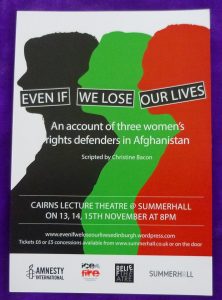
“Even if we lose our Lives” – Amnesty International and the struggle for women’s rights in Afghanistan

Imagine not being able to read or write.  Not because you are unintelligent or too stupid to learn, but because in your country it is forbidden.  Not forbidden for all, though – but only forbidden for women.  Imagine having no rights, having no say in your own life.  No say in who you marry.  No say in your health.  Imagine facing violence and brutality on a daily basis – not just from strangers but also from the people you should be able to trust to care for you, the people who should be there to protect you, not to harm you. Fathers, brothers, uncles, even some of the other women around you: who in an istant can turn on you and inflict pain and humiliation.  And there’s nothing you can do about it.  No safe place to go.  No-one to turn to.  No authorities there to help.

That’s still the fate of far too many women in far too many countries of the world today.  But none more so than in present-day Afghanistan, regarded as one of the most dangerous places in the world to be a woman.

From the word go life is harsh: denied education, 87 percent of Afghan women are  illiterate.  Nearly 80 percent are forced into marriage, with over half of all girls married before they are 19 and very many to much older men.  Giving birth without medical help has led to a maternal mortality rate of 400 in every 100,000 – while here in the UK the ratio is only 8. Domestic violence is almost the norm and redress in the courts virtually non-existent.

Under circumstances such as these, you would expect that any women in a position to leave this horrendous situation would do so.  Yet surprisingly there are women who choose to stay and choose to work and fight towards bettering the lives of Afghan women.

Through the play “Even if we Lose our Lives” Amnesty International tells the stories of three such women. It’s challenging and horrific and moving and shocking and wonderful in turn.  The bravery of these women – and the husbands and children who support them – is at times beyond our understanding.  But they fight on.  This play offers insights into into their lives and actions, told through their own words.

St Marks Amnesty Group in Edinburgh recently staged this work and by doing so transformed the all-too-often faceless and nameless people of Afghanistan into real people, suffering and struggling to make their world even a little bit better.  Their humanity and courage is incredible.  Staged by Alison Martin, Hollie Ruddick and Emily Ingram, this is a play to look out for.

Follow this link to see what you can do to support women in Afghanistan:  Women’s rights in Afghanistan: Amnesty International

And for details of the content of the play see the St Marks Group play website: Even if we lose our Lives

The Fall of the Berlin Wall – BBC Radio Scotland

Bringing down the hated Berlin Wall, 1990

It is 25 years to the day since the Fall of the Berlin Wall – 9th November 1989.  A quarter of a century ago the seemingly impossible happened and that grotesque symbol of a brutal totalitarian regime was breached.  Not through violence or bloodshed, but through the non-violent, patient, persistent refusal of the people of the GDR – East Germany – to tolerate any longer the brutal, unjust and economically inept rule of a decaying communist regime.

It was a day not many had foreseen but what a day of rejoicing it was!  This morning I took part in a discussion of that wonderful time on BBC Radio Scotland’s “Sunday Morning with Ricky Ross” programme.

The Berlin Wall

 
It’s 25 years since the fall of the Berlin Wall. We recall that historic turning point through the perspective of two people who had unique experiences of it at the time, Hans-Dieter Robel and Vivien Martin.

A Piece of the Berlin Wall

A piece of the Berlin Wall just months after ‘The Peaceful Revolution’ when the Wall was finally breached

Believe it or not, but it’s 25 years since the Berlin Wall came down – or rather was brought down by the people of East Germany.  No-one thought it would ever go.  Set in stone, or more accurately in huge slabs of concrete, the Berlin Wall seemed to be there for all time, the bleak physical emblem of a brutal and hypocritical regime, dividing the lives of so many people.  An insurmountable and ever-present barrier.  Yet the spirit and courage of ordinary people were to prove that to be untrue.

From the late 1970s I had been in touch with young East Germans, friends made during an unforgettable visit behind the Iron Curtain in 1978.  I was one of a group of young Scots on a church exchange that was in fact no exchange.  We could enter the GDR, but they were not able to visit us in return.  On our departure at the end of that first remarkable trip we bought our S-Bahn tickets – one way – back to the West.  “Tickets to freedom…” as one of our new friends commented wryly, “…for only a few pfennigs“.  It was a tearful farewell – it didn’t seem likely that we would ever see each other again.

It had been hard enough for us to get there in the first place.  The visit had been discouraged by the GDR, an avowedly atheistic state that regarded both us and our hosts as holding undesirable beliefs, incompatible with the state ideology.  But it was also seen as undesirable in the eyes of the British authorities, who paid me a visit before our departure to encourage us to think twice about going.  However, go we did, facing a long and arduous journey from West to East, past heavily armed guards and grim border crossing points to get there.

Despite all obstacles though, we were determined that from that initial visit onwards this contact should be maintained and we visited whenever we could – later even taking our young daughter Alison with us.  These visits were of immense importance to us all.  We grew to understand the full extent of lives lived under a totalitarian regime, while for our East German friends we were the lifeline to a world outside, proof that other ways were possible. They asked us not to forget them. Through all those years we were deeply impressed by their dignity and courage and determination not to give up hope.

And it was this courage and determination that eventually proved too much for the regime – in November 1989 the Wall came down.  During those exciting – and dangerous – days, our friends would phone us, uncertain as to how much we were able to see in the West.  “Do you know what’s happening?”, “Can you see what’s going on?”  Then a momentous call when Dietmar and Martina rang from Berlin – “The Wall is breached!  We are in West Berlin!  We can hardly believe it’s true!”

But true it was.  I remember so vividly those heady days as the unimaginable happened and the whole edifice of Soviet control began to crumble, finally swept away for good.  As soon as possible we travelled to Berlin and, along with our friends, took up hammer and chisel and helped to bring down that hated edifice that had separated families and countries for so long.

It’s not been an easy transition – no system of government is perfect, but some are definitely better than others.  My friends faced a huge change from one of life to another – new and often daunting challenges – but now they were free from the mental and physical tortures used by the regime to keep the people down.  The Berlin Wall, monstrous in itself, had hidden from the West many of the horrific things done to people who dared to question the state in any way.

The piece of the Berlin Wall that I brought home from that visit is a treasured possession.  The symbol of the courage of my friends, who without weapons, took on a hated regime and brought it down.  My piece of the Wall is a constant reminder to me of their determination in the face of what seemed an indestructible and permanent evil.  My piece of the Wall is a tangible witness to enduring friendships that continue to this day.  Something I will treasure forever.

The story of these remarkable events is told in full in Border Crossings 

Reviews of Border Crossings from Martin Dey and David Pattie

Kildonan – Seal Song on Arran

It was a quiet morning as we followed the path along the shore from Kildonan towards Bennan Head on the southern coast of Arran.  The air was calm, the water unruffled – a lovely September day.  We’d heard that this was a good spot to see seals and sure enough there were people sitting near the start of the path armed with cameras and binoculars.  But not a seal in sight!

So we decided to go further afield and follow the path as far as the Struey Rocks boulderfield.  A sandy beach on one side, dramatic waterfalls on the other made for an interesting walk.  But it became so very much more interesting when we rounded a corner to see dozens of seals basking on the rocks, among them a large number of young animals.  It was a thrill to see so many of them in one place.

Seals basking on the rocks at Kildonan, Isle of Arran

But what really made the day special, however, was their singing.  At first we weren’t quite sure what it was we were hearing, but soon realised they were ‘talking’ to each other – or rather singing to each other!  It was a sound that I remembered from the time when my parents lived in Shetland and my mother would sit on the shore and sing – the seals joining in with their own special song.  And so at Kildonan we sang and to our delight there was a whole chorus of seal voices in response!  It was a wonderful experience and not one that we will forget in a hurry.  And a reminder of just how fortunate we are in Scotland to have so much fascinating nature right on our doorstep.