 “The past is still a place that is not safely settled,” wrote Michael Ondaatje, the Sri Lankan-born Canadian author, best known for his Booker Prize winning novel The English Patient. At the start of Ondaatje’s tale neither the patient’s name nor his past are known, but as the story unfolds his true identity, and the tragic events leading to his desperate state, are gradually revealed.
Just as the history of an individual is uncovered in this many-layered story, so archaeologists continue to delve into the past, unearthing new levels and discovering artefacts that reveal ever more about our country’s history and the lives of our ancestors.

The entrance to the Basilica di San Clemente
It’s surprising how often we think of the past as something fixed and final – but nothing could be further from the truth. The past is not static and archaeology and historical research are our tools for learning more. As new finds come to light, we’re able to reassess our understanding of how people lived in bygone days.
Some years ago I read Ngaio Marsh’s novel When in Rome, where her suave gentleman detective Roderick Alleyn joins a select group on a murderous tour of the Basilica (Church) di San Tommaso. The setting is based on the real Basilica di San Clemente, an ancient site where archaeologists have discovered at least three levels of buildings, the oldest being deep under the present ground level.
On top is the 12th century basilica. Below that archaeologists have unearthed a 4th-century basilica, originally part of the sumptuous home of a Roman nobleman. Below that again, a lower basement served as a mithraeum (a temple for the worship of Mithras) until that religion was outlawed.
It’s even possible that the home of that wealthy Roman nobleman had been built on the foundations of a much older republican-era building, which was destroyed in the Great Fire of 64 AD. These exciting discoveries have shed a great deal of light on the turbulent history of Rome and the varied lifestyles of its inhabitants.

The crypt at St Colman’s Church
But what about Portmahomack? Similar far-reaching discoveries were made here between 1994 and 2007, when archaeologists uncovered the site of what seems to be the largest Pictish Christian Monastery in Scotland. Founded around 560 AD, perhaps even by Columba himself, this monastery in Pictland grew and flourished for the next 300 years. Archaeological evidence suggests that the monastery had a farm and a cemetery, as well as workshops for the making of sacred church objects, intricate sculptures, and illustrated books (similar to the Book of Kells).
The Picts have long been one of history’s great mysteries, but discoveries like these at Pormahomack have given us unique insights into their civilisation. They were not simply the barbaric ‘painted’ warriors of Roman propaganda, but an artistic, highly cultured people, skilled craftsmen, well-organized, well-travelled and not isolated from contemporary politics and events, with Portmahomack a key point on the North Sea trade routes.
But then tragedy struck when, around 800 AD, the monastery and the surrounding community were destroyed by Viking invaders. The wonderful treasure that was this unique Pictish monastery was reduced to rubble and gradually disappeared beneath the earth, to be eventually forgotten.

Portmahomack
But sacred sites draw people to them, and other churches were built on this hallowed ground. Until finally, centuries later, gravediggers unearthed fragments of ancient carved stones and it became clear that something very ancient and substantial lay beneath their feet. And the re-discovery began.
One way or another we are all shaped by the past. A better understanding of that makes for a better understanding of ourselves. And who knows what else is waiting to be discovered?
You can read about this, and much more, in my article in the March/April 2019 issue of iScot magazine.
Tarbat Discovery Centre

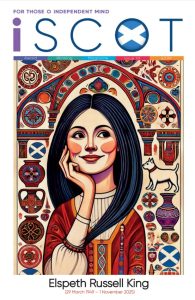 In May 2018 I had the privilege of interviewing Dr Elspeth King, not long before her retirement from the Stirling Smith Museum. She had so much to say that the article ran to nine pages in the May 2018 edition of iScot Magazine!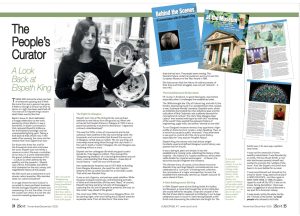
 Have you ever found yourself walking through a supermarket and suddenly realised that you’re humming along to the music playing quietly in the background? Music that’s familiar, even if, like many of us, you can’t remember the words after the first couple of lines!
 How time flies! It’s 30 years since the Fall of the Berlin Wall and 5 years since

 The 25th of January 2019 sees the 260th anniversary of the birth of Robert Burns. Burns has been voted the Greatest Scot by the Scots themselves and his work is known and admired the world over. For a man who died when he was only thirty-seven, that really is an amazing achievement.
 How fortunate we are to have a man like Burns as part of our nation’s history and culture. How worthwhile it is to take a longer look at who he was and what he did. How worthy he is of that glass raised in his honour at your Burns Supper – a man whose works are definitely worth remembering, not just on the 25th of January, but all year round!

 Among the speakers are the journalist and broadcaster Lesley Riddoch; Maggie Chapman, co-convenor of the Scottish Green Party and Rector of Aberdeen University; Prof Sarah Pederson of Robert Gordon’s University, who led the influential ‘Suffragettes in North East Scotland’ project; Aberdeenshire East MSP, Gillian Martin; Petra Pennington, Art and Community worker at Deveron Projects; Alison Evison, president of COSLA and Dr. Cait Murray-Green, CEO of a young Scottish company Cuantec, which produces compostable packaging from langoustine shells, a natural alternative to plastic. An impressive line-up!
 There’s a lovely poem of William Blake’s, Auguries of Innocence, which opens with these lines: “To see a World in a Grain of Sand And a Heaven in a Wild Flower, Hold Infinity in the palm of your hand And Eternity in an hour”: sentiments echoed in the writings of the 19th century Austrian author and poet Adalbert Stifter, who believed that if you couldn’t see wonder and beauty in a tiny flower, then you were missing some of the greatest glories around us.
 What wonderful, bold and stirring words! Perhaps doubly so when you realise they were written by a woman living in 16th-17th century Scotland. Even though I studied Scottish History at Edinburgh University, I have to confess I’d never heard of Elizabeth Melville. Though as I was a student some decades ago now, that’s perhaps not totally surprising. Women have tended to be left on the back-burner when it comes to academic recognition. So it’s great that she’s finally being acknowledged for all that she achieved.
 It’s thanks to Dr Jamie Reid-Baxter, a Scottish historian and former European Parliament translator, who has championed her work and brought it to attention as never before. In March 2017 he wrote a lengthy and fascinating article for iScot magazine, and from reading that I learned that Elizabeth was published in 1603, making her Scotland’s first woman in print. Her poem, Ane Godlie Dreame, was such a success that by 1606 it was into its third edition, and by 1735 had gone through at least thirteen editions. Jamie describes the work thus, “480 lines long, it is a dramatic account of the human spirit’s journey from depression and despair to final affirmation, on a cosmic scale.”
 exist because of the struggles of people like Elizabeth Melville. To simply shrug off their beliefs and actions is to demean and belittle the sacrifices of previous generations. And who knows what future generations will smile at about the things we hold dear today!
 the women who went before us. As Jamie says, “People do want to take ownership of long-suppressed aspects of Scotland’s past. The role of the female 50% in creating what we know as Scotland is acknowledged in the Great Tapestry of Scotland, but most of the female images are anonymous because history has been written by men for men.”


 It’s a place I’ve been back to on many occasions and I’ve written about some of the things that made this place special not just to me and my family, but to many others. It’s good to have places like this, places that played their part in our young lives and continue to hold such a store of fond memories. Whilst I’d still find it impossible to name a favourite place, High Corrie comes pretty close!