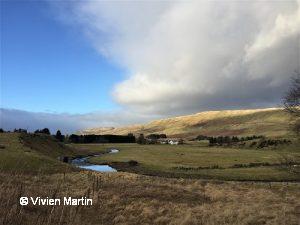
Lower Diabaig
The Beatles famously sang about a ‘long and winding road’, and while it might lead to the door of a loved one, I think we would all agree that it would be a much more comfortable journey on a road that is smooth and not one made from crushed rock and gravel. And yet that’s exactly what many roads in the Highlands were like until the 1960s and 70s.
Travel was hard going. Communities could only survive and thrive if travel and communications were, if not good, at least adequate. And very often they were neither. But the eventual arrival of tarred roads was to make a great, and very positive, difference to the lives of people in remote areas.

‘Cycling county’ 1930s style!
The roads around Loch Torridon in Wester Ross were a classic example of the tough going involved. A time when travelling by bike, bus or car involved a ‘right good jolting’ for both passengers and goods.
Poor roads also helped exacerbate worrying trends in depopulation, as they made trading, shopping, visiting friends and family, getting to secondary school, to church, to hospital, to and from work all much more difficult. While some today may hanker to be ‘off the beaten track’, it most certainly wasn’t always seen as a good thing!
Fortunately much has improved not only for Torridon’s residents but also for the many visitors drawn to this area of rugged and spectacular beauty. From the dizzying heights of Beinn Alligin, Liathach and Beinn Eighe to the rolling breakers and dunes at Redpoint Beach, there’s much to experience. And we are fortunate to be able to do so with an ease and comfort that our forebears could only dream of!
 In the current issue of iScot magazine I take a look at the story behind the lives of the people of Torridon both past and present. At the challenges faced both then and now. And how we owe a great deal to those who went before us. It’s a fascinating area and though remote, there’s much more to it than you might at first believe.


 The Covid pandemic has turned life upside down. So many things that we took for granted suddenly became impossible. For the benefit of everyone, we’ve had to curtail travel and holiday plans. Frustrating perhaps, but a frustration that pales into insignificance in light of the horrendous loss of life all four nations of the UK have sustained.
 Yet even when we’re not in the midst of a pandemic, we’re still in a position to travel and explore ‘virtually’. To read and think about places we want to see again and to discover new places that we can look forward to visiting when the time comes. For me, one of those places is Wester Ross. We’ve visited many times before and hope to visit again when circumstances allow.
 For those of us who live in more densely populated areas, Wester Ross is often regarded as remote or isolated. But that’s a misconception. Not only is Wester Ross no stranger to excitement or danger, it’s also an area of outstanding scenic beauty. And rich in history. Everything from
 Angus Blue and his team are back. A shooting on a Scottish island opens up a can of worms. Those in power want to keep it closed. But DI Blue’s not one for giving up.
  The action moves between Scotland, England, Ireland and Germany, as Blue and his team home in on a crime covered up by those who should know better.


 I often wonder what he and his contemporaries would make of Westminster today? Not a lot, I suspect. But without a shadow of a doubt, there’s much that today’s politicians could learn from Tom Johnston!
  It should have been happening this September, however, like so much at the moment, it’s been put on hold. Yes, that’s disappointing, but I suspect it’ll be twice as enjoyable when it does take place!
 There’s no doubt about it – North Uist can be windy! But that didn’t really bother us when we spent our summer holidays there a year or so ago. We’re used to Scottish weather, whatever the season. And we know how to dress for everything Scottish weather can throw at us – be it spring, summer, autumn or winter (and sometimes they can be hard to differentiate!)
 The last resident of the island came to a sticky end – thrown into a dungeon in a castle on Skye and left, not to starve to death, but given salted beef with nothing to drink and left to die slowly and agonisingly of thirst. Not a pleasant way to go!
 When we come out at the other end of this corona virus pandemic, just how will we look back at what happened to us, to our families, to our communities? Every generation lives through history in the making, but when you’re in the middle of events the end result is unknown: you don’t have the luxury of hindsight. And that uncertainty isn’t just unsettling. It’s frightening.


 The good and the bad. The joyous and the heartbreaking. Bravery in the face of war and cruelty. Kindness and generosity in times of adversity. The exciting and the mundane. The patterns of day-to-day life.
 What connects a Highland wilderness, a former east-coast fishing town and Glasgow’s respectable West End? The answer? Crime! But fear not, it’s fictional crime I’m talking about!
 In the Highlands I’m often struck by that curious juxtaposition between the breathtaking landscapes and the tiny settlements scattered across them. Towering mountains and huge skies. All that space and yet so few people. What made Gareth Halliday chose this place for his debut novel From the Shadows?
 A document that contains the famous lines, “For so long as but a hundred of us remain alive, we shall never under any circumstances submit to the domination of the English. It is in truth not for glory, nor riches, nor honours that we are fighting, but for freedom alone, which no honest man gives up but with life itself.” And this is the ancient town where Jackie McLean sets her crime novels.
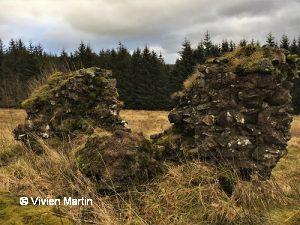
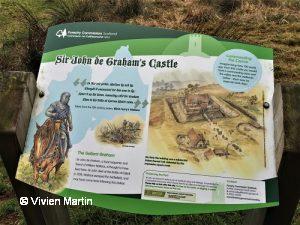
 The view might be very different from John de Graham’s time, but the setting is still as commanding. De Graham, friend and ally of William Wallace, is believed to have had his home on this spot, overlooking the Carron Valley in Stirlingshire. There’s a picture on the information board showing what the ‘castle’ would have looked like: a medieval earthwork with a substantial timber-framed hall, defended by an impressive square moat. The line of the moat is still very much in evidence, though nothing remains of the hall, and today the mighty Carron Reservoir fills much of the valley below.
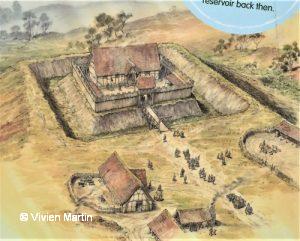 John de Graham of Dundaff (another name for this fortified site), was a 13th century Scottish noble who fought alongside Wallace in the First Scottish War of Independence, and who fell at the Battle of Falkirk on 22 July 1298. On that terrible day the Scots, unable to withstand the force of the heavy English armoured cavalry and the deadly Welsh longbows, were defeated by Edward I of England. De Graham died but Wallace survived and is said to have sought out de Graham’s body and carried it from the battlefield himself. De Graham was the most notable casualty of that terrrible day and is buried at Falkirk Old Parish Church. Wallace then retreated to de Graham’s home by the Carron Water.
 Many years later a famous narrative poem, The Actes and Deidis of the Illustre and Vallyeant Campioun Schir William Wallace (also known as The Wallace), was written by the poet Blind Harry. It portrays Sir John de Graham as one of William Wallace’s principal supporters and describes Wallace’s feelings of loss and sadness at the demise of his friend. There’s no doubt that de Graham’s death was a sore blow to Wallace, who lost not only his right-hand-man, but also a close friend.
 Ritchie continues, “Although Blind Harry’s poem was written long after the event, it does clearly link his Sir John de Graham to the area; and although the earthwork was likely built some years beforehand, it does mark the feudal estate of Dundaff, property of the de Graham family. Fact and fiction do seem to meet at Sir John de Graham’s castle to tell a story of place that is firmly rooted in the past.”