

My mother aged 16
Just think for a moment about what makes each one of us a unique individual. It’s our memories. And just think how tragic it is when we lose those, when dementia strikes and robs us of who we are. Author Julian Barnes wrote, “Memory is identity….You are what you have done; what you have done is in your memory; what you remember defines who you are; when you forget your life you cease to be, even before your death.”
A few years ago I lost my mother to cancer. Yet in some ways I’d lost her to Alzheimer’s before that. I’m sure many others have gone through the same loss. As her memories went, the person she was gradually slipped away. It’s a terrible thing to happen. I remember vividly the day she looked at me and asked “What did your mother do?” “A good question!” I replied, trying not to cry. That comment however, spurred me to write a biography of her life. I contacted those who had known her at different stages of her life: growing up in India, teaching in one of the toughest schools in Glasgow, as well as in schools in London and Shetland, travelling to Bosnia in the wake of that terrible war, campaigning in local elections in Edinburgh. For a time, even as her memories gradually disappeared, looking at what she called “The Book”, helped her cope with what was happening to her, reminded her for a while of the person she had been and the life she had led. Words and images that spoke of her history, and offered brief respites from that insidious disease that was slowly but surely robbing her of her identity.
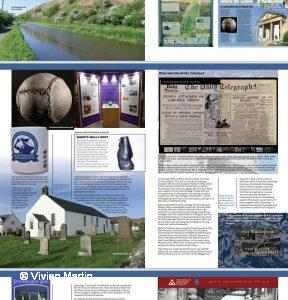 I’ve written about these issues before, but feel they’re worth revisiting because loss of identity doesn’t only apply to individuals, but also to nations. If we lose our collective memories we lose our identity as a people. What is it that makes us who we are? What are the experiences that shape and define us? The circumstances that create our beliefs and values? What are the factors that have made Scotland the country it is today; the country we call home?
Intriguing questions that lead in turn to the question of how we preserve our identity, both as individuals and as nations. How do we protect the integrity of our past, our history, our heritage? Why are some people and events remembered and celebrated, while others are brushed to one side, forced into obscurity? And why did so many of us in Scotland grow up with so little knowledge of the rich history of our own country?
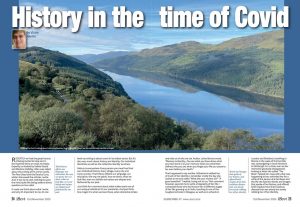 In this month’s iScot article I look at all these fascinating issues and at the wealth of places that exist that make it possible for us to know more about our past and, by extension, ourselves. If we hope to create a better future for ourselves and our country, we have to not only be able to make sense of the present but also to understand the role of the past in our lives. Our history is preserved in a myriad of ways. The more we learn about it, the more we want to know. And it’s all just waiting for us out there!
 The computer keyboard is getting well worn! From the author of The Peat Dead and The Dead of Jura, comes the first book in a spectacular new series – Death in Tallinn.


 In the current issue of iScot magazine I take a look at the story behind the lives of the people of Torridon both past and present. At the challenges faced both then and now. And how we owe a great deal to those who went before us. It’s a fascinating area and though remote, there’s much more to it than you might at first believe.


 The Covid pandemic has turned life upside down. So many things that we took for granted suddenly became impossible. For the benefit of everyone, we’ve had to curtail travel and holiday plans. Frustrating perhaps, but a frustration that pales into insignificance in light of the horrendous loss of life all four nations of the UK have sustained.
 Yet even when we’re not in the midst of a pandemic, we’re still in a position to travel and explore ‘virtually’. To read and think about places we want to see again and to discover new places that we can look forward to visiting when the time comes. For me, one of those places is Wester Ross. We’ve visited many times before and hope to visit again when circumstances allow.
 For those of us who live in more densely populated areas, Wester Ross is often regarded as remote or isolated. But that’s a misconception. Not only is Wester Ross no stranger to excitement or danger, it’s also an area of outstanding scenic beauty. And rich in history. Everything from

 Angus Blue and his team are back. A shooting on a Scottish island opens up a can of worms. Those in power want to keep it closed. But DI Blue’s not one for giving up.
 The action moves between Scotland, England, Ireland and Germany, as Blue and his team home in on a crime covered up by those who should know better.


 I often wonder what he and his contemporaries would make of Westminster today? Not a lot, I suspect. But without a shadow of a doubt, there’s much that today’s politicians could learn from Tom Johnston!
 It should have been happening this September, however, like so much at the moment, it’s been put on hold. Yes, that’s disappointing, but I suspect it’ll be twice as enjoyable when it does take place!

 There’s no doubt about it – North Uist can be windy! But that didn’t really bother us when we spent our summer holidays there a year or so ago. We’re used to Scottish weather, whatever the season. And we know how to dress for everything Scottish weather can throw at us – be it spring, summer, autumn or winter (and sometimes they can be hard to differentiate!)

 The last resident of the island came to a sticky end – thrown into a dungeon in a castle on Skye and left, not to starve to death, but given salted beef with nothing to drink and left to die slowly and agonisingly of thirst. Not a pleasant way to go!
 When we come out at the other end of this corona virus pandemic, just how will we look back at what happened to us, to our families, to our communities? Every generation lives through history in the making, but when you’re in the middle of events the end result is unknown: you don’t have the luxury of hindsight. And that uncertainty isn’t just unsettling. It’s frightening.


 The good and the bad. The joyous and the heartbreaking. Bravery in the face of war and cruelty. Kindness and generosity in times of adversity. The exciting and the mundane. The patterns of day-to-day life.