
 He was once a character known the world over, yet today Wee Macgreegor is little more than a footnote to Scottish literature. First published in 1902, the tale of wee Macgregor Robinson and his family made writer and journalist J J Bell (John Joy Bell), an overnight sensation. Wee Macgreegor soon featured in many other novels, and was so popular it wasn’t long before he became a brand – on matches, china, biscuits, tablet, lemonade and even sardines!
John Bell was the son of a prosperous Glasgow tobacco manufacturer and enjoyed all that that entailed. After university John briefly joined the family firm, however writing was his real passion and, with his father’s blessing, he began writing for newspapers and magazines. But just as John’s star began to rise, his father’s company sank upon the rocks of American competition in the trans-Atlantic battle for supremacy of the vastly profitable tobacco trade.

From iScot April/May 2019
An unassuming man, Bell was surprised, but pleased, when the books were dramatised for stage, radio and cinema. In 1911 Arthur Wareing, director of the Glasgow Repertory Theatre, suggested Bell adapt some of the stories for his company to perform. The Glasgow Rep had been established in 1909 in an attempt to break the stranglehold which the London touring companies had gained in Scottish theatres. Sadly, the company would be short-lived, falling victim to the wave of theatre closures caused by the outbreak of World War One.

Harold Chapin
However, working with a young American producer and playwright, Harold Chapin, Bell had the play ready by December 1911. Finding a boy to play the part of Wee Macgreegor wasn’t easy. But one of Bell’s former Evening News colleagues came to his aid, finding ‘a likely lad’ for them. This was Willie Elliot, a messenger-boy, a small fourteen-year-old, who although he had no ambition to become an actor, was able and intelligent and made a successful job of the part. Both Harold Chapin and Willie Elliot would later be caught up in the First World War, Chapin volunteering for the medical corps and losing his life in 1915 at the Battle of Loos. While Willie Elliot, although wounded three times, survived that bloodbath and after the war left Scotland to start a new life in Canada.

Betty Balfour
In 1923 a silent film, Wee MacGregor’s Sweetheart, appeared. The film told the story not of the eight-year-old boy, but the young man and was based on two later stories, Oh! Christina and Courting Christina, with the role of Christina played by Betty Balfour, one of the best-known actresses of the day. Betty Balfour was known as the ‘British Mary Pickford’, and worked in Germany and France, as well as appearing in one of Alfred Hitchcock’s earliest films, Champagne (1928).
I found it fascinating trying to track down the people, places and events that were part of J J Bell’s life. While he seems to have been a very quiet, almost reserved man, his writing brought him into contact with people from all walks of life. Up until his death in 1934, Bell continued to contribute to newspapers, was a theatre critic, produced some autobiographical volumes and wrote widely about Scotland, most notably The Glory of Scotland (1932) and The Rainbow West (1933).
 One of his favourite, and oft-repeated journeys, was on the West Highland Railway up to Fort William and on to the fishing port of Mallaig. The growth of railways had opened up parts of Scotland that had previously only been accessible to the very wealthy. Now travel was there for all.
Bell’s love of Scotland was great, and he felt very strongly that, for all of us, personal knowledge of our land was important, “for after all, we ought to know for ourselves – not depending entirely on Sir Walter Scott – the land we love.”
And as for the mystery of the three nuns? You’ll have to read the iScot article to find the answer to that!!
 “It was a dark and stormy night …” I wonder how many stories have opened with those famous words? Words first penned by American author Washington Irvine in 1809. Although much parodied, it’s an opening phrase that was used to great effect by Madeleine L’Engle in her ground-breaking novel A Wrinkle in Time, a book that had a profound influence on me as a child. L’Engle opened the door to a whole generation of children in the 1960s onwards with her stories that combined science fiction and fantasy with the spiritual and questions of good and evil. The first in a series, the book went on to win many literary awards and be dramatised for stage, radio, television and film.
 Scotland, with its wealth of islands, has long been fruitful territory for crime writers, perhaps the best known being Peter May and Ann Cleeves, featuring the Hebrides and Shetland respectively. But there are many others and in the current issue of Scottish Islands Explorer I look at novels by two Scottish authors, Lin Anderson and Craig Robertson, who use distinctive and very different island settings for their characters’ dark deeds!
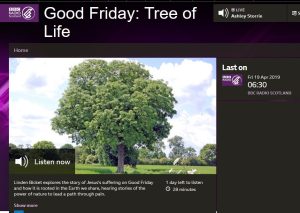 I was honoured to be invited to take part in this programme which looks at how important the natural world (in particular trees and forests) is to out physical and spiritual well-being.
 “The past is still a place that is not safely settled,” wrote Michael Ondaatje, the Sri Lankan-born Canadian author, best known for his Booker Prize winning novel The English Patient. At the start of Ondaatje’s tale neither the patient’s name nor his past are known, but as the story unfolds his true identity, and the tragic events leading to his desperate state, are gradually revealed.


 The 25th of January 2019 sees the 260th anniversary of the birth of Robert Burns. Burns has been voted the Greatest Scot by the Scots themselves and his work is known and admired the world over. For a man who died when he was only thirty-seven, that really is an amazing achievement.
 How fortunate we are to have a man like Burns as part of our nation’s history and culture. How worthwhile it is to take a longer look at who he was and what he did. How worthy he is of that glass raised in his honour at your Burns Supper – a man whose works are definitely worth remembering, not just on the 25th of January, but all year round!
 There are one or two places on the west coast of Scotland that are not islands as such, but which are, to all intents and purposes, islands. Scoraig on Little Loch Broom in Wester Ross is one. To reach Scoraig you can either go by boat (the easy way – though always weather dependent!) from Badluarach on the south shore of Little Loch Broom – or you can walk. There is no road, no vehicular access, only a dramatic 5-mile cliff-side path. This was the route we chose. The walk starts at the road end at Badralloch and offers spectacular views down the length of Little Loch Broom.
 But battle on they did, and that so many survived is a tribute to the courage and determination of the inhabitants. Life continued, families grew and according to Scoraig’s community website, there were 61 children at the school in 1873. However, as steamer transport declined and road and rail routes passed Scoraig by – as well as the drastic toll of two world wars – the population began to dwindle and it looked as though Scoraig was finished.


 Spent time in a queue in the Post Office recently? Stamps for Christmas cards? Parcels to post? This is probably the one time of year many of us use stamps. They’re such small things that we tend to take them for granted. Yet, before their introduction in 1840, you had to be rich to communicate with anyone who didn’t live close to home. The Penny Post was a huge, beneficial, change for ordinary people and letter writing flourished. Postcards appeared and greeting cards for every occasion soon followed.

 The vital contribution made by postal workers was celebrated in the 1936 GPO film Night Mail, with W.H. Auden’s famous poem recited to the rhythm of the rushing wheels of the train.
 Time and tide may wait for no man, but the hills do. And in Scotland we have some of the most magnificent hills and mountains in the world. Mountains that were forced into being over 400 million years ago when three continents collided, creating a mountain chain of umimaginable proportions. Mountains that, over millenia, have been worn away by ice, wind and water to reach the forms we see today.


 Holiday accommodation comes in all shapes and sizes. Sometimes the reality turns out to be not quite as it seemed in the brochure, while on other occasions you arrive to find it’s even better than expected. Coillabus on Islay was one of those, especially when we arrived at the lodge and saw the breathtaking 180° views over the north-west of the Oa. In fact, we could even see all the way along Glen Astle to the Rinns of Islay lighthouse on the small island of Orsay!
 Set into the hillside, the lodge is almost invisible from the road, with curving stone walls and a turf roof that blend into the surrounding landscape: “Traditional black house meets neolithic with a healthy dose of contemporary chic”, as one description imaginatively puts it! And that’s not far wrong. Even the instructions on how to get there were magical: “The road becomes narrow with twisty corners in places. Continue past…the house with hens and other livestock. Go up round past Connachan’s Grave, a chambered cairn on your left…then up a really steep bend past a house with…more hens who might be responsible for your breakfast eggs”! How often do you get directions like this!
 However, there is continuity with the island’s past as the Coillabus lodges lie within a family-owned working hill farm and were built with local stone by local craftsmen. The modern, environmentally-friendly underfloor heating makes for a warm and comfortable stay. We were fortunate to have good weather during our visit, but the lodge is so well insulated the weather almost didn’t matter! In fact, you could say it’s a ‘weatherproof’ house where the drama of a storm raging outside would be thrilling to watch through the magnificent panoramic windows.
 In the current issue of Scottish Islands Explorer I look at some of the ways architects are taking the best from the past and combining it with modern technology. Coillabus, and properties like it, give the lie to the notion that eco-friendly living means a primitive existence! In Scotland we’re well on the way to meeting our electricity needs through renewables. Using air and ground source heat pumps, it’s great to see a growing number of buildings where the old meets the new to create something both sustainable and comfortable – and in this case very much in keeping with a glorious island setting. Coillabus is undoubtedly an example of the way to go!