

Finnich Glen, The Whangie and the Auld Wives’ Lifts all feature in October’s iScot
Question: What’s the connection between Outlander and the lost Roman legion in the film The Eagle?
Answer: The dark, dank and decidedly creepy gorge in Finnich Glen, that comes complete with a curious sandstone rock known as the Devil’s Pulpit!
Imagine you’re a film producer and you need a location that’s shadowy, murky and menacing. Somewhere timeless and atmospheric. Secret, subterranean and definitely spooky. The gorge at Finnich Glen, also known locally as the Devil’s Pulpit, fits the bill exactly. And so it was that it came to feature in both the Outlander television series and the film The Eagle.
 South of Drymen, the gorge is 100ft deep, at times very narrow, with sheer, dripping moss-covered walls. An old Victorian stone stairway is one way down to the bottom of the gorge. Over the decades the steps have slipped and become precipitous. Winter gales have brought down trees, some of which have crashed onto the steps, dislodging sections. But despite that it’s still possible to get down as ropes have been strung across the most difficult sections.
Several scenes in the feature film The Eagle, starring Jamie Bell, Channing Tatum and Donald Sutherland, were filmed in the gorge. The plot is closely based on Rosemary Sutcliff’s novel The Eagle of the Ninth, which was written in 1954, and has remained popular ever since. It was the first in a very successful series of stories set in Roman Britain and recounts the tale of the mysterious disappearance of the Ninth Legion. A mystery, and a matter of heated debate among historians, to this day.
 Diana Gabaldon’s phenomenally popular Outlander series, has caught the public imagination and interest in its filming locations in immense. Finnich Glen is the setting for St. Ninian’s Spring, where a drink from the sulfurous water acts as a type of lie-detector. Should Claire lie to Dougal after drinking it, she will suffer dire consequences. However, she tells him again that she is not a spy and remains unharmed, at which point Dougal finally accepts this as the truth. This ‘truth forcing spring’ has brought more and more visitors to Finnich Glen.
But what does the devil have to do with it? And why his pulpit? The answer may lie close-by in another strange and outlandish geological feature known as the Whangie, a very popular local walk and climb. Legend has it that Auld Nick, the devil, finding himself very late for a meeting at the local witches’ coven, rounded the mountain so swiftly that his tail sliced through the hillside, creating the bizarre cleft called the Whangie. Perhaps the Devil’s Pulpit was where he had been lurking with dubious companions beforehand. Who can tell!

Gorge walking in Finnich Glen
The gorge is a natural sandstone canyon created over millennia by the fast-moving waters of the Carnock Burn. Over-topped by a canopy of trees, the gorge can feel very enclosed and shut-off from the outside world. It can also be strangely silent, with no other sound than that of the ever-present rushing water.
And it should be mentioned that, in-between being a spectacular film location, Finnich Glen is an equally spectacular gorge-walking and outdoor adventure site.
It’s not necessarily a place for the fainthearted, but if Claire, Esca and Marcus could all get there and live to tell the tale, then so could you!
 In 1986 the Guardian newspaper showed a powerful advert in which a skinhead looks as though he’s about to rob a pedestrian. Then the whole scene is revealed and rather than being a thief, the skinhead is in fact saving the man’s life, dragging him to safety as a pile of bricks crashes down from the scaffolding overhead.
 Sometimes all it takes is a slight shift in perspective and a whole new scenario opens up in front of us. Take the time to look at things from a different standpoint, and you’ll find a lot can change. In a way it’s a bit like the fake news that’s so prevalent today. We need to step back and look at the other side of the coin before believing what we’re being told to believe. What we’re being presented with as ‘truth’. But we’re intelligent beings. We can think. We can ask questions. Ask for proof before simply accepting the newspaper headlines
 It could be easy to overlook Eilean Bàn as the mighty Skye Bridge soars overhead. But it’s an island with a long and interesting history, and a visit to the Gavin Maxwell Museum or the island’s impressive wildlife hide is a worthwhile day out.

 Among the speakers are the journalist and broadcaster Lesley Riddoch; Maggie Chapman, co-convenor of the Scottish Green Party and Rector of Aberdeen University; Prof Sarah Pederson of Robert Gordon’s University, who led the influential ‘Suffragettes in North East Scotland’ project; Aberdeenshire East MSP, Gillian Martin; Petra Pennington, Art and Community worker at Deveron Projects; Alison Evison, president of COSLA and Dr. Cait Murray-Green, CEO of a young Scottish company Cuantec, which produces compostable packaging from langoustine shells, a natural alternative to plastic. An impressive line-up!
 There’s a lovely poem of William Blake’s, Auguries of Innocence, which opens with these lines: “To see a World in a Grain of Sand And a Heaven in a Wild Flower, Hold Infinity in the palm of your hand And Eternity in an hour”: sentiments echoed in the writings of the 19th century Austrian author and poet Adalbert Stifter, who believed that if you couldn’t see wonder and beauty in a tiny flower, then you were missing some of the greatest glories around us.
 How quick we can be to label other people. To slot them into categories. Pigeonhole them. And, yes, it can make them easier to deal with. But also easier to ignore or dehumanise. Shades of “But of course s/he’s (add your own label), and you know what they’re like!” Case dismissed.
 And perhaps we have choices to make as well. Do we go along with the ‘buffoonery’ that in reality hides a toxic attitude to any kind of social justice, and which is damaging not just individuals, but actively dismantling the very fabric of our society; or do we say ‘Enough is enough’? What sort of country do we want to live in and leave to the next generation? We look back and applaud the Chartists, the Abolitionists, the Suffragettes, the young men who died in senseless wars. But we face as grave a challenge to our society as they ever did – the ball’s in our court now. What are we going to do with it?
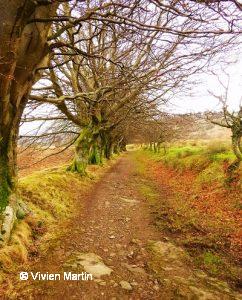
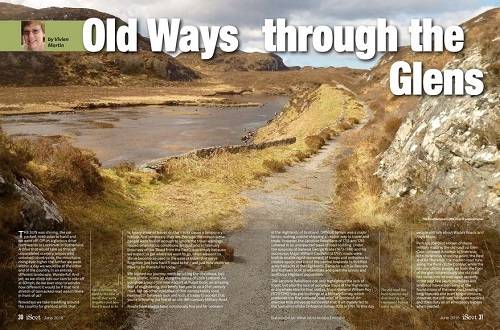 We may not always realise it, but it’s surprising how often we’re following in the footsteps of General Wade or Thomas Telford when we travel around Scotland; particularly the further north we go. And though their roads were fairly basic, they were undoubtedly a great improvement on what went before, when the majority of people had no alternative but to walk and roads were virtually non-existent.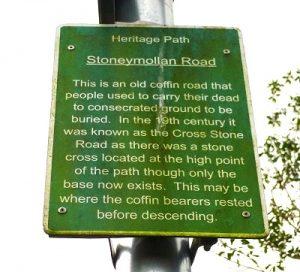

 What is it that makes us who we are? What are the experiences that shape and define us? The circumstances that create our beliefs and values? What are the factors that have made Scotland the country it is today; the country we call home? Intriguing questions that lead in turn to the question of how we preserve our identity, both as individuals and as nations. How do we protect the integrity of our past, our history, our heritage? And crucially, who is it that decides what is important, or significant enough to be preserved? Why are some people and events remembered and celebrated, while others are brushed to one side, forced into obscurity? These were some of the questions I put to Dr Elspeth King, director of the Stirling Smith Museum, and her answers were enlightening.


 I’ve been reliably informed by an elderly neighbour that Scotland is going to enjoy really good weather in May and June this year. In theory they should be good months weather-wise, but as that’s not always the case, I’m glad to have this confirmed by neighbourly bunions!


 Gerda Stevenson is a woman of very many talents: actor, playwright, director, poet, singer, song-writer, to name but a few. Now she’s turned again to poetry to draw our attention to the lives and achievements – as well as the hardships and challenges – of sixty-seven amazing Scottish women. Women who deserve our admiration and respect. But first of all we need to know of their existence, for too often women are written out of history and allowed to become invisible.
 Quines: poems in tribute to women of Scotland was four years in the writing. Much reading, researching and tracking down of sources went into getting to know the women she wanted to write about. Women whom she found inspiring and hopes others will find inspirational too.
 I’m grateful that Gerda has brought these women out of the shadows and back into the light. And we need as much light as we can get these days! But I also feel strongly that it’s Gerda’s own strength of character and determination that has achieved this. Her life and beliefs are inspirational too. She’s as much one of these Quines as any of her subjects. And I hope that’s what my article conveys.