
 There are one or two places on the west coast of Scotland that are not islands as such, but which are, to all intents and purposes, islands. Scoraig on Little Loch Broom in Wester Ross is one. To reach Scoraig you can either go by boat (the easy way – though always weather dependent!) from Badluarach on the south shore of Little Loch Broom – or you can walk. There is no road, no vehicular access, only a dramatic 5-mile cliff-side path. This was the route we chose. The walk starts at the road end at Badralloch and offers spectacular views down the length of Little Loch Broom.
Until the mid 1800s the peninsula supported a number of farming townships: houses grouped together surrounded by feannagan – ridge and furrow rigs for growing crops. By the mid-19th century, however, the estate had been sold and the new owner dramatically changed the landscape of the area by breaking up the townships and laying out crofts. These were hard, harsh times in the Highlands and Islands. New homes had to be built from scratch, infertile land worked until a living could be eked from it. And all the while increased rents, both in kind and in labour, were being demanded by landlords.
 But battle on they did, and that so many survived is a tribute to the courage and determination of the inhabitants. Life continued, families grew and according to Scoraig’s community website, there were 61 children at the school in 1873. However, as steamer transport declined and road and rail routes passed Scoraig by – as well as the drastic toll of two world wars – the population began to dwindle and it looked as though Scoraig was finished.

The path alongside Little Loch Broom towards Scoraig
But surprisingly Scoraig didn’t die. The story of the hard-work, determination and ingenuity that have kept Scoraig alive is one well-worth the telling. And in this month’s Scottish Islands Explorer I’ve tried to do just that. It’s a story with plenty of hardship and heartbreak along the way, especially when resistance from landowners doomed a ground-breaking post-war scheme to rebuild and repopulate the area. But persistance paid off and a new wave of settlers arrived in the 1960s and 1970s and have succeeded in rebuilding this unique community.

New housing in Scoraig!
Back then some of their practices were regarded as odd – but their approach to self-sufficiency, wind and solar power are now seen as the way forward for the rest of us. They were real innovators, hard-working pioneers ahead of their time. And thanks to them, Scoraig has continued to grow and thrive; that the community supports a nursery and a primary school is proof of that. What was once seen as ‘alternative’ living has stood the test of time and proven its worth. And can teach us all something for the challenges we face today.

The jetty at Scoraig
 Spent time in a queue in the Post Office recently? Stamps for Christmas cards? Parcels to post? This is probably the one time of year many of us use stamps. They’re such small things that we tend to take them for granted. Yet, before their introduction in 1840, you had to be rich to communicate with anyone who didn’t live close to home. The Penny Post was a huge, beneficial, change for ordinary people and letter writing flourished. Postcards appeared and greeting cards for every occasion soon followed.

 The vital contribution made by postal workers was celebrated in the 1936 GPO film Night Mail, with W.H. Auden’s famous poem recited to the rhythm of the rushing wheels of the train.
 Time and tide may wait for no man, but the hills do. And in Scotland we have some of the most magnificent hills and mountains in the world. Mountains that were forced into being over 400 million years ago when three continents collided, creating a mountain chain of umimaginable proportions. Mountains that, over millenia, have been worn away by ice, wind and water to reach the forms we see today.


 Holiday accommodation comes in all shapes and sizes. Sometimes the reality turns out to be not quite as it seemed in the brochure, while on other occasions you arrive to find it’s even better than expected. Coillabus on Islay was one of those, especially when we arrived at the lodge and saw the breathtaking 180° views over the north-west of the Oa. In fact, we could even see all the way along Glen Astle to the Rinns of Islay lighthouse on the small island of Orsay!
 Set into the hillside, the lodge is almost invisible from the road, with curving stone walls and a turf roof that blend into the surrounding landscape: “Traditional black house meets neolithic with a healthy dose of contemporary chic”, as one description imaginatively puts it! And that’s not far wrong. Even the instructions on how to get there were magical: “The road becomes narrow with twisty corners in places. Continue past…the house with hens and other livestock. Go up round past Connachan’s Grave, a chambered cairn on your left…then up a really steep bend past a house with…more hens who might be responsible for your breakfast eggs”! How often do you get directions like this!
 However, there is continuity with the island’s past as the Coillabus lodges lie within a family-owned working hill farm and were built with local stone by local craftsmen. The modern, environmentally-friendly underfloor heating makes for a warm and comfortable stay. We were fortunate to have good weather during our visit, but the lodge is so well insulated the weather almost didn’t matter! In fact, you could say it’s a ‘weatherproof’ house where the drama of a storm raging outside would be thrilling to watch through the magnificent panoramic windows.
 In the current issue of Scottish Islands Explorer I look at some of the ways architects are taking the best from the past and combining it with modern technology. Coillabus, and properties like it, give the lie to the notion that eco-friendly living means a primitive existence! In Scotland we’re well on the way to meeting our electricity needs through renewables. Using air and ground source heat pumps, it’s great to see a growing number of buildings where the old meets the new to create something both sustainable and comfortable – and in this case very much in keeping with a glorious island setting. Coillabus is undoubtedly an example of the way to go!
 South of Drymen, the gorge is 100ft deep, at times very narrow, with sheer, dripping moss-covered walls. An old Victorian stone stairway is one way down to the bottom of the gorge. Over the decades the steps have slipped and become precipitous. Winter gales have brought down trees, some of which have crashed onto the steps, dislodging sections. But despite that it’s still possible to get down as ropes have been strung across the most difficult sections.
 Diana Gabaldon’s phenomenally popular Outlander series, has caught the public imagination and interest in its filming locations in immense. Finnich Glen is the setting for St. Ninian’s Spring, where a drink from the sulfurous water acts as a type of lie-detector. Should Claire lie to Dougal after drinking it, she will suffer dire consequences. However, she tells him again that she is not a spy and remains unharmed, at which point Dougal finally accepts this as the truth. This ‘truth forcing spring’ has brought more and more visitors to Finnich Glen.
 In 1986 the Guardian newspaper showed a powerful advert in which a skinhead looks as though he’s about to rob a pedestrian. Then the whole scene is revealed and rather than being a thief, the skinhead is in fact saving the man’s life, dragging him to safety as a pile of bricks crashes down from the scaffolding overhead.
 Sometimes all it takes is a slight shift in perspective and a whole new scenario opens up in front of us. Take the time to look at things from a different standpoint, and you’ll find a lot can change. In a way it’s a bit like the fake news that’s so prevalent today. We need to step back and look at the other side of the coin before believing what we’re being told to believe. What we’re being presented with as ‘truth’. But we’re intelligent beings. We can think. We can ask questions. Ask for proof before simply accepting the newspaper headlines
 It could be easy to overlook Eilean Bàn as the mighty Skye Bridge soars overhead. But it’s an island with a long and interesting history, and a visit to the Gavin Maxwell Museum or the island’s impressive wildlife hide is a worthwhile day out.
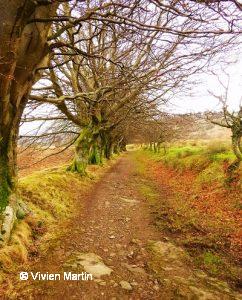
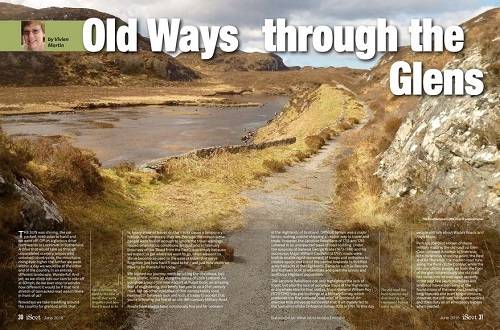 We may not always realise it, but it’s surprising how often we’re following in the footsteps of General Wade or Thomas Telford when we travel around Scotland; particularly the further north we go. And though their roads were fairly basic, they were undoubtedly a great improvement on what went before, when the majority of people had no alternative but to walk and roads were virtually non-existent.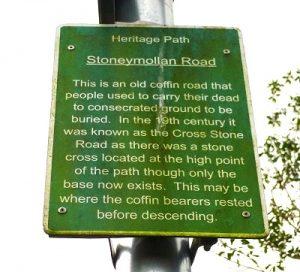

 What is it that makes us who we are? What are the experiences that shape and define us? The circumstances that create our beliefs and values? What are the factors that have made Scotland the country it is today; the country we call home? Intriguing questions that lead in turn to the question of how we preserve our identity, both as individuals and as nations. How do we protect the integrity of our past, our history, our heritage? And crucially, who is it that decides what is important, or significant enough to be preserved? Why are some people and events remembered and celebrated, while others are brushed to one side, forced into obscurity? These were some of the questions I put to Dr Elspeth King, director of the Stirling Smith Museum, and her answers were enlightening.


 I’ve been reliably informed by an elderly neighbour that Scotland is going to enjoy really good weather in May and June this year. In theory they should be good months weather-wise, but as that’s not always the case, I’m glad to have this confirmed by neighbourly bunions!


