
 For those living in the Central Belt of Scotland the countryside is never far away. Despite being the area with the highest population density in Scotland (3.5 million out of 5.4 million), it doesn’t take long to reach the clean air and open spaces of the countryside.
For many of us, heading north or west leads to the Trossachs, an area of woods, glens and lochs that lies within the Loch Lomond and Trossachs National Park. And right in the middle of this expanse is glorious Glen Finglas.
Made famous by Walter Scott (as with so much of this part of Scotland), Glen Finglas has never lost its popularity, and today is managed by the Woodland Trust for Scotland. But it’s also part of ‘a forest in the making’, the Great Trossachs Forest, a long-term project (200 years!) that aims to create 160 square km of native woodland across this area. This innovative and far-sighted venture is the brainchild of the Forestry Commission Scotland, RSPB Scotland and the Woodland Trust. Described as a ‘forest for the future’, the Great Trossachs Forest is also the largest National Nature Reserve in the country. Quite an achievement.

A cottage in the village of Brig O’Turk, Glen Finglas
While this work is being carried out in the present and will provide great benefits for the future, Glen Finglas has a long and varied past. And it’s this past that has shaped the landscape we see here today.
In the current issue of iScot magazine I’ve written about the past, present and future of Glen Finglas under the headings found on the unusual stone compass that’s set into a rocky hillock up the glen. Carved into the stone are three mottoes: Enjoy the Present, Sense the Past, Ensure the Future. It’s a wonderful encouragement to get out and walk (or cycle), to learn about the people and events that have gone before and to discover what is planned for future generations.
To find out more about what this all entails, get hold of a copy of September’s iScot and then be inspired to pay a visit yourself!
 ‘Climb every mountain …’
 Unlike the characters at the opening of Lin Anderson’s new novel, we weren’t trapped in the Cairngorms by a blizzard. Unlike them we were free to walk away from the Cairngorms Mountain Rescue (CMR) Base in Inverdruie whenever we chose. And unlike her fictional protagonists, we wanted to be where we were. We’d come Aviemore for the weekend to hear about the 12th book in the Rhona MacLeod series, Follow the Dead.


 Crime writing in Scotland has never been more popular. From


 Sometimes we like to think that our ancestors were far more superstitious that us: less sophisticated, less modern or up-to-date. But pay a visit to your local cinema and take a look at the large number of films full of vampires, zombies, ghosts and horrific creatures: all there to scare the living daylights out of us. And we even pay for the pleasure! It’s curious, isn’t it. Just what is it in us that enjoys being terrified and faced with such primeval fears?
 Aberfoyle, wondered just that. He collected folklore and stories from local people about their experiences with the supernatural. He then examined biblical references and asked whether there might in fact be a class of ethereal beings in this world which we didn’t yet understand, or could fully explain. He’s remembered today as The Fairy Minister, which tends to belittle him, and makes it easy to shrug of his work. But who really knows? And sometimes it’s worth keeping an open mind on such matters!
 Certainly you’ll find that his grave is, more often than not, covered in coins, put there by the superstitious of today hoping for some good luck from their gesture. Or at the Minister’s Tree atop Doon Hill, where there’s a ‘clootie well’, with so many pieces of cloth that the whole hill top can look fairly dirty and untidy. Yet these things are put there as ‘wishes’ to the fairies: or to whatever power may be willing to offer assistance. I sometime wonder if we’re really much less superstitious today after all.
 It’s easy to dismiss small or seemingly remote communites as offering nothing much of interest. But that’s a very mistaken assumption. Everywhere has a history. Everywhere the impact of human life leaves a mark. And small places are no different. In fact, it’s in these places that change is often felt more intensely and with far greater repercussions.
 Maxwell and his otters, sailing over the sea to Skye: Glenelg has all that and much, much more. I know Glenelg well and have visited often, but I still find there’s always something more just waiting to be experienced.


 It’s a place I’ve been back to on many occasions and I’ve written about some of the things that made this place special not just to me and my family, but to many others. It’s good to have places like this, places that played their part in our young lives and continue to hold such a store of fond memories. Whilst I’d still find it impossible to name a favourite place, High Corrie comes pretty close!
 … as well as being great for making Gorse Flower Tea, can also be used to make the most delicious Gorse Flower Cordial, or Gorse Flower Syrup, or Gorse Flower Wine.


 It’s genuinely remote, there are plenty of obstacles to getting there, but it can be done – and it’s definitely worth it! Time of year, weather and MOD activity in the bombardment range, all have to be taken into consideration before you set out. Once these factors are sorted, however, you’re on your way. And fear not – there will be a cup of tea waiting for you when you finally reach the lighthouse!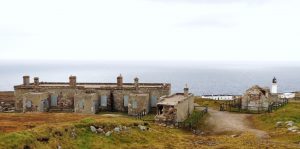
 Cape Wrath was the hvarf, the ‘turning point’ for the Vikings. Life is full of turning points and our reactions to these can have a profound effect on how we live our lives and relate to those around us. At times life can be more challenging than we might prefer, but, with places like Cape Wrath to visit, at least we can’t complain that it’s dull!